Needlepoint Canvas Mesh Sizes: 10 to 18 Mesh
Mesh is holes per inch: 100 stitches are 10" on 10-mesh, 7.69" on 13-mesh, 5.56" on 18-mesh. Mesh sizes side by side with stitches per square inch and needle sizes.
https://needlenook.app/learn/needlepoint-canvas-mesh-sizes
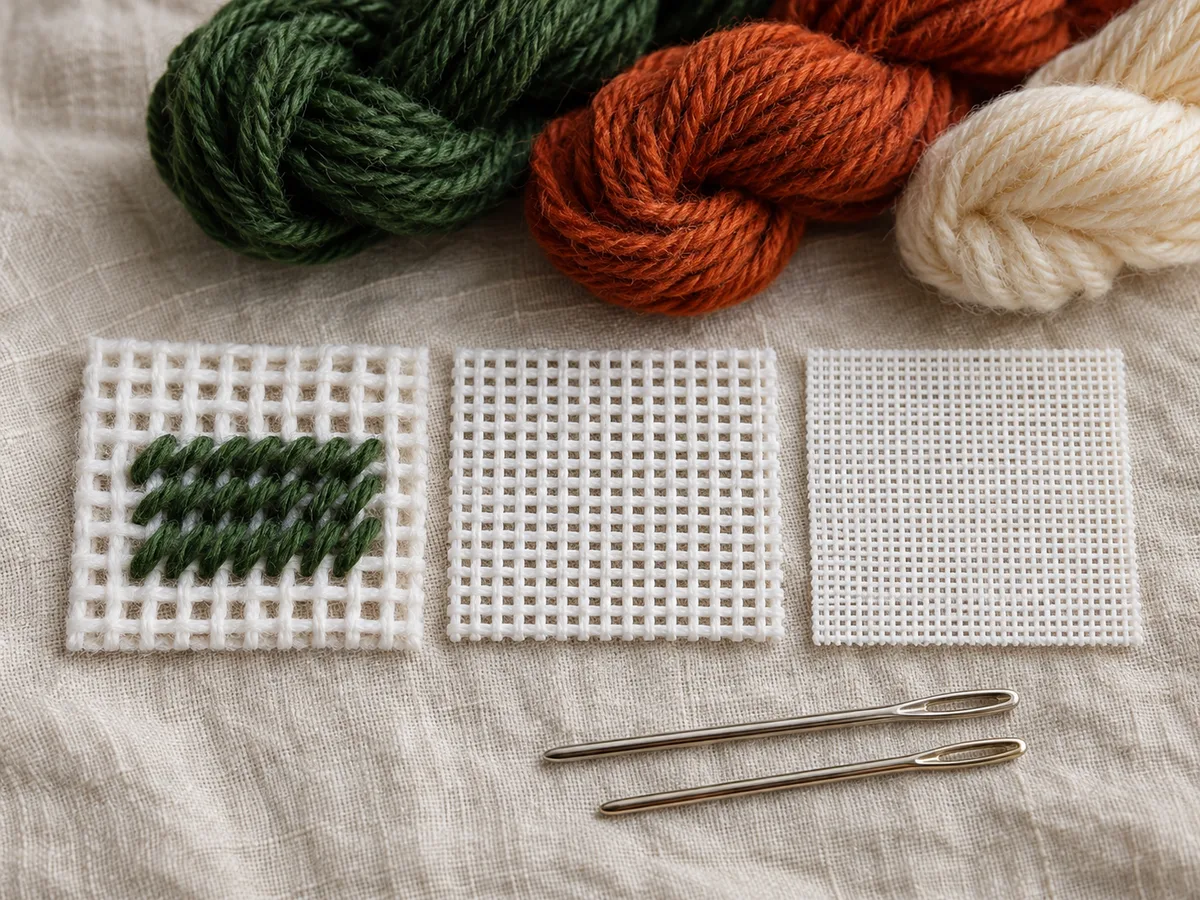
Mesh is the number of holes per inch, so it sets both detail and size: the same 140 × 100-stitch design is 14" × 10" on 10-mesh, 10.77" × 7.69" on 13-mesh and 7.78" × 5.56" on 18-mesh. The deciding factor is usually the thread you want to use and how much detail the design needs.
The tables below put 10, 12, 13, 14 and 18-mesh side by side: stitches per square inch, finished size, the canvas to cut with a 3" margin (the same margin as the needlepoint chart maker), and the tapestry needle sizes that DMC, Penny Linn and Kreinik suggest. The needle advice differs between these sources by one size, so the table shows both.
Key points
- Mesh = holes (and tent stitches) per inch. Finished size = stitches ÷ mesh.
- Stitches per square inch = mesh × mesh: 100 on 10-mesh, 169 on 13-mesh, 324 on 18-mesh.
- A 14" × 14" pillow front is 33,124 stitches on 13-mesh and 63,504 on 18-mesh.
- Needles: DMC and Penny Linn suggest size 18 for 10–12 mesh, 20 for 12–14 mesh and 22 for 18-mesh; Kreinik suggests 22 for 13–14 mesh and 24 for 18-mesh.
- Lower mesh takes thicker thread such as tapestry wool or size 3 pearl cotton; higher mesh takes finer thread such as size 5 pearl cotton (DMC).
The deciding factor: detail against stitching time
Penny Linn puts it plainly: the smaller the mesh number, the bigger the holes. A 13-mesh canvas is quicker to stitch, carries a less detailed painting and needs a thicker thread; an 18-mesh canvas takes longer, holds more detail and needs thinner threads. Herrschners gives the arithmetic: a 10-mesh canvas has 10 holes, or 10 stitches, to the inch, which is 100 stitches per square inch.
Because both directions scale, the stitch count grows with the square of the mesh. A 14" × 14" pillow front is 19,600 stitches on 10-mesh, 33,124 on 13-mesh and 63,504 on 18-mesh, more than three times the 10-mesh count. Neither choice is better in general; the right one depends on the detail you want and the time you have.
Mesh sizes side by side
Herrschners lists mono canvas in 10, 12, 13, 14 and 18-mesh, and interlock canvas in the same five sizes. The needle columns are the sources' rules of thumb; DMC and Penny Linn agree with each other, and Kreinik suggests one size finer on 13, 14 and 18-mesh to avoid distorting the canvas. A higher needle number is a finer needle.
| Mesh | Stitches per sq in | 100 stitches measure | Needle (DMC, Penny Linn) | Needle (Kreinik) |
|---|---|---|---|---|
| 10 | 100 | 10" (25.4 cm) | 18 | Not listed |
| 12 | 144 | 8.33" (21.2 cm) | 18 or 20 | Not listed |
| 13 | 169 | 7.69" (19.5 cm) | 20 | 22 |
| 14 | 196 | 7.14" (18.1 cm) | 20 or 22 | 22 |
| 18 | 324 | 5.56" (14.1 cm) | 22 | 24 |
Finished size and canvas to cut
Divide the stitch count by the mesh for the finished size, then add a margin on every side for the canvas you cut. This guide uses 3" per side, the same margin as the needlepoint chart maker, and rounds the cut up to the next 1/4". The 3" margin is this site's planning assumption, not a figure from the sources; framers and finishers may ask for a different margin, so check with yours first. The table uses a 140 × 100-stitch design and the stitches for a 14" × 14" pillow front.
| Mesh | 140 × 100 design | Canvas to cut (3" margin) | 14" × 14" pillow front |
|---|---|---|---|
| 10 | 14" × 10" | 20" × 16" | 140 × 140 stitches |
| 12 | 11.67" × 8.33" | 17 3/4" × 14 1/2" | 168 × 168 stitches |
| 13 | 10.77" × 7.69" | 17" × 13 3/4" | 182 × 182 stitches |
| 14 | 10" × 7.14" | 16" × 13 1/4" | 196 × 196 stitches |
| 18 | 7.78" × 5.56" | 14" × 11 3/4" | 252 × 252 stitches |
Mono, interlock and Penelope canvas
Mono canvas has single threads in both directions. Herrschners notes it is easy for beginners and suits any needlepoint stitch except half cross stitch. Interlock canvas wraps its horizontal threads around the vertical ones, which DMC says makes it more stable; it is common in kits and lighter in weight, which Herrschners suggests for smaller framed pieces.
Penelope (also called duo or double-thread) canvas has pairs of threads. DMC explains that its count is often written as two numbers, such as 5/10: the second number is the stitches per inch if you work over single threads. Herrschners adds that Penelope is the canvas used for petit point, and that plastic canvas comes in 7 and 10-mesh for items that need firm edges.
- Mono: single threads, any stitch except half cross.
- Interlock: locked intersections, stable, lighter weight.
- Penelope: double threads, two counts such as 5/10, petit point possible.
- Plastic: 7 or 10-mesh, cut edges do not unravel.
Matching thread to the mesh
DMC groups threads by mesh: thicker threads such as tapestry wool, soft cotton or size 3 pearl cotton for lower counts, and finer threads such as size 5 pearl cotton or six-strand embroidery floss for higher counts. Penny Linn's own thread list follows the same split, with size 3 pearl cotton under 13-mesh and size 5 pearl cotton under 18-mesh.
The needle then follows the thread. Herrschners gives a simple test: if the yarn is hard to pull through the eye, the needle is too small; if the yarn moves around loosely in the eye, the needle is too large. Kreinik says the needle should fit the thread without being so large that it distorts the canvas.
What to check before you cut the canvas
Count the holes in one inch along a ruler to confirm the mesh; a painted canvas is usually labelled, a blank one may not be. Divide your chart's stitch count by that mesh and compare the result with the space or the pillow form it is for. Thread one length of your chosen thread and pass it through the canvas a few times; DMC suggests a needle that enters the canvas with little or no drag on the thread. Bind the cut edges with masking tape, as DMC recommends, so the canvas does not unravel or catch the thread.
Common questions
- What is the difference between 13 and 18 mesh needlepoint canvas?
- 18-mesh has 324 stitches per square inch against 169 on 13-mesh, almost twice as many. The same chart stitched on 18-mesh comes out about 28% smaller each way, with finer detail, thinner thread and more stitching time.
- What size needle for 18 mesh canvas?
- DMC suggests a size 22 tapestry needle for 16 to 18-mesh and Penny Linn for 14 to 18-mesh; Kreinik suggests a size 24 on 18-mesh. Thread your chosen thread and use the size that passes through the canvas without drag and without loose movement in the eye.
- What does 10 mesh mean in needlepoint?
- Ten holes per inch, so ten tent stitches per inch each way and 100 stitches per square inch (Herrschners). A 100-stitch-wide design is 10" wide on 10-mesh canvas.
- Can I stitch a cross-stitch chart on needlepoint canvas?
- Yes. One chart square becomes one tent stitch, so the size is the stitch count divided by the mesh: a 140-stitch-wide chart is 10.77" wide on 13-mesh. The needlepoint vs cross-stitch guide compares the two crafts.
About this page
Written and reviewed by Maeve, Editor, Needle Nook. Last reviewed . General craft guidance; check your own gauge and measurements before cutting or stitching.
Facts on this page follow these references:
- What Canvas Do I Need for Tapestry or Needlepoint? ↗DMC
- Needlepoint Materials ↗Herrschners
- Basic Needlepoint Terms to Know ↗Penny Linn
- Needle Selection Chart ↗Kreinik Manufacturing