How Much Fabric Do I Need for a Quilt?
Quilt fabric from your cut pieces: strips across a 40" usable width, rounded up to 1/8 yard. Chart for crib to king, with backing and binding.
https://needlenook.app/learn/how-much-fabric-for-a-quilt
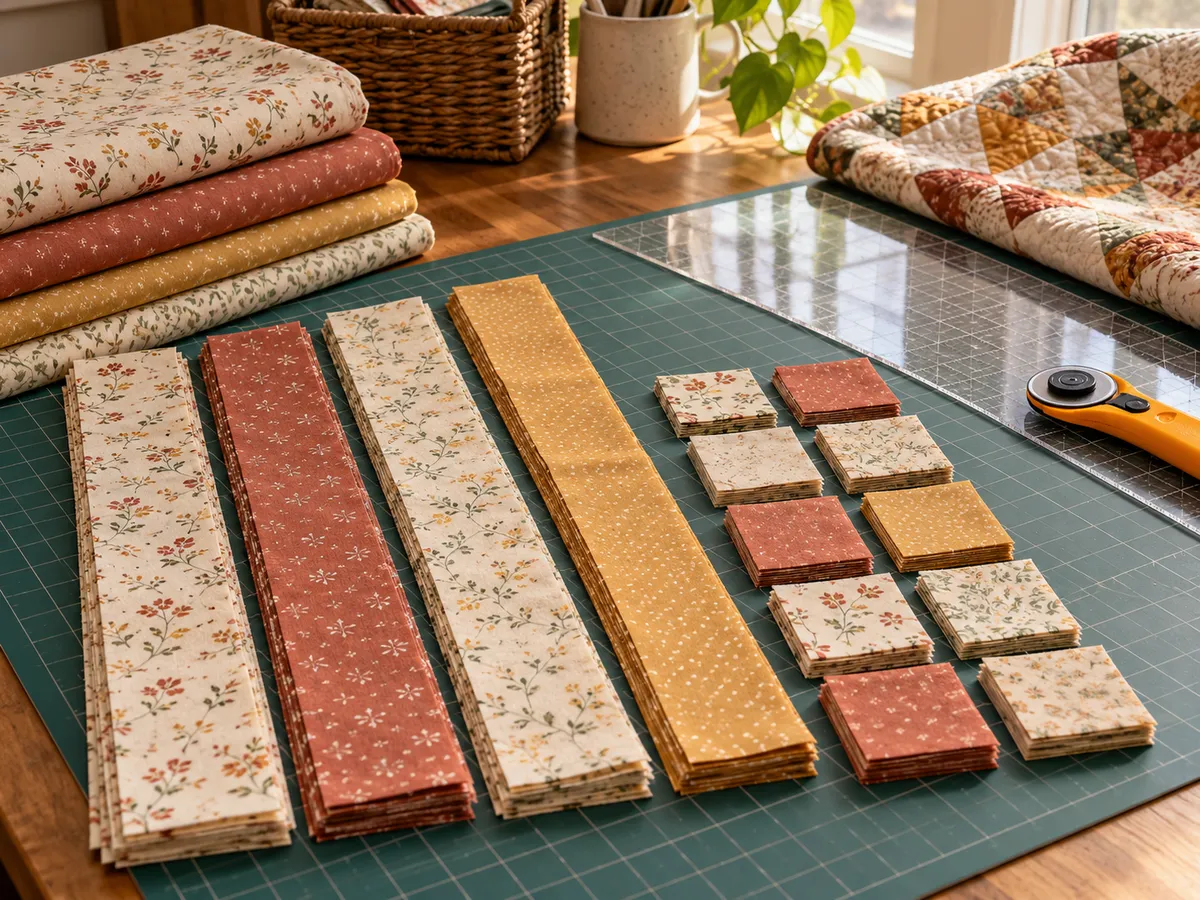
Count the pieces, fit them into 40" (101.6 cm) strips, and round the total up to the nearest 1/8 yard. For a 50" x 60" (127 x 152.4 cm) throw made of 5" finished squares in two alternating fabrics, that comes to 1 3/8 yards of each fabric.
Every number on this page rests on one assumption: 40" of usable width once the selvages are trimmed and the fabric is squared up. The sections show the arithmetic step by step, a chart of top, backing and binding yardage for crib to king, and what to check before the first cut.
Key points
- Cut each square at its finished size plus 1/2" so a 1/4" seam allowance sits on every side.
- Plan with 40" of usable width per strip; quilting cotton loses its selvages and some width when squared up.
- Pieces per strip = 40 ÷ cut width, rounded down. Strips needed = pieces ÷ pieces per strip, rounded up.
- Yardage = strips × strip width, rounded up to the next 1/8 yard (4.5", or 11.43 cm).
- Binding and backing are separate calculations; add them to the top fabric total.
The short formula for quilt yardage
Quilt yardage is a counting problem. Every piece in the top comes from a strip cut across the width of the fabric (WOF), so you only need four numbers: the cut size of the piece, how many pieces you need, how many fit across one strip, and how deep each strip is. Multiply the number of strips by the strip depth and you have the length of fabric to buy.
The assumptions matter as much as the arithmetic. This guide assumes 40" (101.6 cm) of usable width after the selvages are trimmed and the fabric has shrunk or been squared up. Missouri Star Quilt Co. uses the same 40" planning width for 42" quilting cotton. If your fabric is wider and you have measured it after prewashing, you can use the larger figure, but 40" leaves a safe margin.
- Cut size = finished size + 1/2" for squares and rectangles.
- Pieces per strip = 40 ÷ cut width, rounded down to a whole number.
- Strips = pieces needed ÷ pieces per strip, rounded up.
- Inches of fabric = strips × strip depth.
- Yards = inches ÷ 36, rounded up to the next 1/8 yard (4.5").
Why squares are cut 1/2" larger
Quilters piece with a 1/4" (0.64 cm) seam allowance, and a square loses 1/4" on each of its four sides when it is sewn into the top. Across any one direction that is two seams, so the cut square must be 1/2" (1.27 cm) larger than the finished square. A 5" finished square is cut at 5 1/2"; a 4" finished square is cut at 4 1/2".
The Quilt Show notes that some patterns call for a scant 1/4" seam and that the right seam is whichever one gives you the planned finished size. Test your seam on two scrap strips before cutting a whole quilt, because a seam that is slightly too wide shrinks every block in the top.
How many squares fit in one 40" strip
Cut a strip as deep as the square, then cross-cut it into squares. The table shows how many squares one 40" strip gives for common finished sizes. Each figure is 40 divided by the cut size, rounded down, because a partial square is waste.
| Finished square | Cut size | Squares per 40" strip |
|---|---|---|
| 2" (5.1 cm) | 2 1/2" (6.4 cm) | 16 |
| 3" (7.6 cm) | 3 1/2" (8.9 cm) | 11 |
| 4" (10.2 cm) | 4 1/2" (11.4 cm) | 8 |
| 5" (12.7 cm) | 5 1/2" (14 cm) | 7 |
| 6" (15.2 cm) | 6 1/2" (16.5 cm) | 6 |
| 8" (20.3 cm) | 8 1/2" (21.6 cm) | 4 |
| 10" (25.4 cm) | 10 1/2" (26.7 cm) | 3 |
| 12" (30.5 cm) | 12 1/2" (31.8 cm) | 3 |
Worked example: a 50" x 60" throw
A throw that finishes at 50" x 60" (127 x 152.4 cm) from 5" finished squares has 10 squares across (50 ÷ 5) and 12 squares down (60 ÷ 5), so it needs 10 × 12 = 120 squares. With two fabrics in a checkerboard, each fabric supplies 60 squares.
Each square is cut at 5 1/2", so one 40" strip gives 7 squares (40 ÷ 5.5 = 7.27, rounded down). For 60 squares you need 60 ÷ 7 = 8.57 strips, rounded up to 9. Nine strips 5 1/2" deep use 9 × 5.5 = 49.5" (125.7 cm) of fabric. That is exactly 11 eighths of a yard (49.5 ÷ 4.5 = 11), so you buy 1 3/8 yards of each fabric.
If the whole top were one fabric, the same steps give 120 ÷ 7 = 17.14, rounded up to 18 strips, and 18 × 5.5 = 99" (251.5 cm). That is 22 eighths, or 2 3/4 yards. Notice that two half-quantities (1 3/8 + 1 3/8) also total 2 3/4 yards here, but that will not always happen, because each fabric is rounded up on its own.
Rectangles, mixed sizes and leftovers
Rectangles follow the same rule: add 1/2" to both the finished width and the finished height. Cut the strip as deep as one side and cross-cut by the other. Try both orientations, because one of them often fits more pieces per strip.
When a fabric appears in several piece sizes, work out the strips for each size separately and add the inches together before rounding. Rounding each size up on its own overstates the yardage. You can also cross-cut smaller pieces from the leftover end of a strip, but a plan that ignores leftovers will never leave you short.
Binding, backing and borders are extra
The top fabric total does not include binding or backing. Binding is cut as 2 1/2" strips whose total length covers the perimeter plus extra for joins and corners, and backing is a separate piece 4" larger than the top on every side. Borders are long strips and are planned the same way as binding: total length needed, divided by 40", rounded up to whole strips.
- Binding: 2 1/2" strips, length = perimeter + 10".
- Backing: add 8" to each dimension of the top.
- Borders: strips cut at the finished border width + 1/2".
How much fabric for a crib, throw, twin, queen or king quilt
This chart runs the same arithmetic for a whole quilt in one fabric of 5" finished squares, so you can see the scale before you plan your own design. It uses the quilt generator's rules: squares cut at 5 1/2", backing 8" larger than the top in each direction and joined with 1/2" seams in whichever direction uses less fabric, and binding of 2 1/2" strips for the perimeter plus 10". Sizes are picked from the typical finished ranges in the quilt sizes chart on this site and rounded to whole 5" squares.
A real quilt with several fabrics, sashing or borders needs its own count, and each fabric rounds up on its own, so the total for a scrappy top is usually a little higher. Batting is separate.
| Quilt (finished) | Top: 5" squares | Backing | Binding |
|---|---|---|---|
| Crib 40" x 60" | 96 squares, 2 1/4 yd | 48" x 68", 2 3/4 yd | 6 strips, 1/2 yd |
| Throw 50" x 65" | 130 squares, 3 yd | 58" x 73", 3 1/4 yd | 6 strips, 1/2 yd |
| Twin 65" x 90" | 234 squares, 5 1/4 yd | 73" x 98", 5 1/2 yd | 8 strips, 5/8 yd |
| Queen 90" x 105" | 378 squares, 8 1/4 yd | 98" x 113", 8 1/4 yd | 10 strips, 3/4 yd |
| King 110" x 110" | 484 squares, 10 3/4 yd | 118" x 118", 9 7/8 yd | 12 strips, 7/8 yd |
What to check before you cut
Measure the usable width of your own fabric after prewashing, because 40" is a planning figure, not a guarantee. Confirm whether your pattern sizes are finished or cut sizes, since mixing the two is the most common reason a plan comes out short. Finally, cut one strip, cross-cut it, and count the pieces before cutting the rest. The quilt pattern generator on this site runs this same arithmetic for every fabric in a layout, so you can compare its totals with your own.
Common questions
- How many yards of fabric do I need for a queen quilt?
- For a 90" x 105" queen top of 5" squares in one fabric: 8 1/4 yards for the top, 8 1/4 yards of 40"-usable backing and 3/4 yard for binding, so 17 1/4 yards of cotton in all. A design with several fabrics needs its own count.
- How much fabric do I need for a throw quilt?
- A 50" x 65" throw of 5" squares in one fabric takes 3 yards for the top, 3 1/4 yards for the backing and 1/2 yard for binding.
- Why use 40 inches when quilting cotton is sold as 42 to 44 inches wide?
- The selvages are cut off, the fabric may shrink when washed, and the edge is squared up before cutting. Planning with 40" of usable width covers those losses, which is the same planning width Missouri Star Quilt Co. uses for 42" cotton.
- Why round up to the nearest 1/8 yard?
- Many shops cut fabric in 1/8 yard steps, which is 4.5" (11.43 cm). Rounding up to the next step means the length you buy always covers every strip you planned.
- Should I add extra fabric for mistakes?
- The 40" planning width already gives some margin. If you are new to rotary cutting or the fabric is directional, buying one extra strip depth of the fabric is a simple safety step.
- Does this work for fat quarters?
- The same counting works, but a fat quarter is a different shape from a WOF strip. Count how many cut pieces fit on the measured fat quarter instead of using the 40" strip figure.
About this page
Written and reviewed by Claire, Editor, Needle Nook. Last reviewed . General craft guidance; check your own gauge and measurements before cutting or stitching.
Facts on this page follow these references:
- How to Calculate Quilt Backing Yardage ↗Missouri Star Quilt Co.
- What is a Seam Allowance? ↗The Quilt Show