Quilt Binding and Backing Yardage Calculator Guide
How much binding and backing fabric a quilt needs: 2 1/2" strips for perimeter plus 10", backing 4" larger on every side, and which way to seam it.
https://needlenook.app/learn/quilt-binding-and-backing-yardage
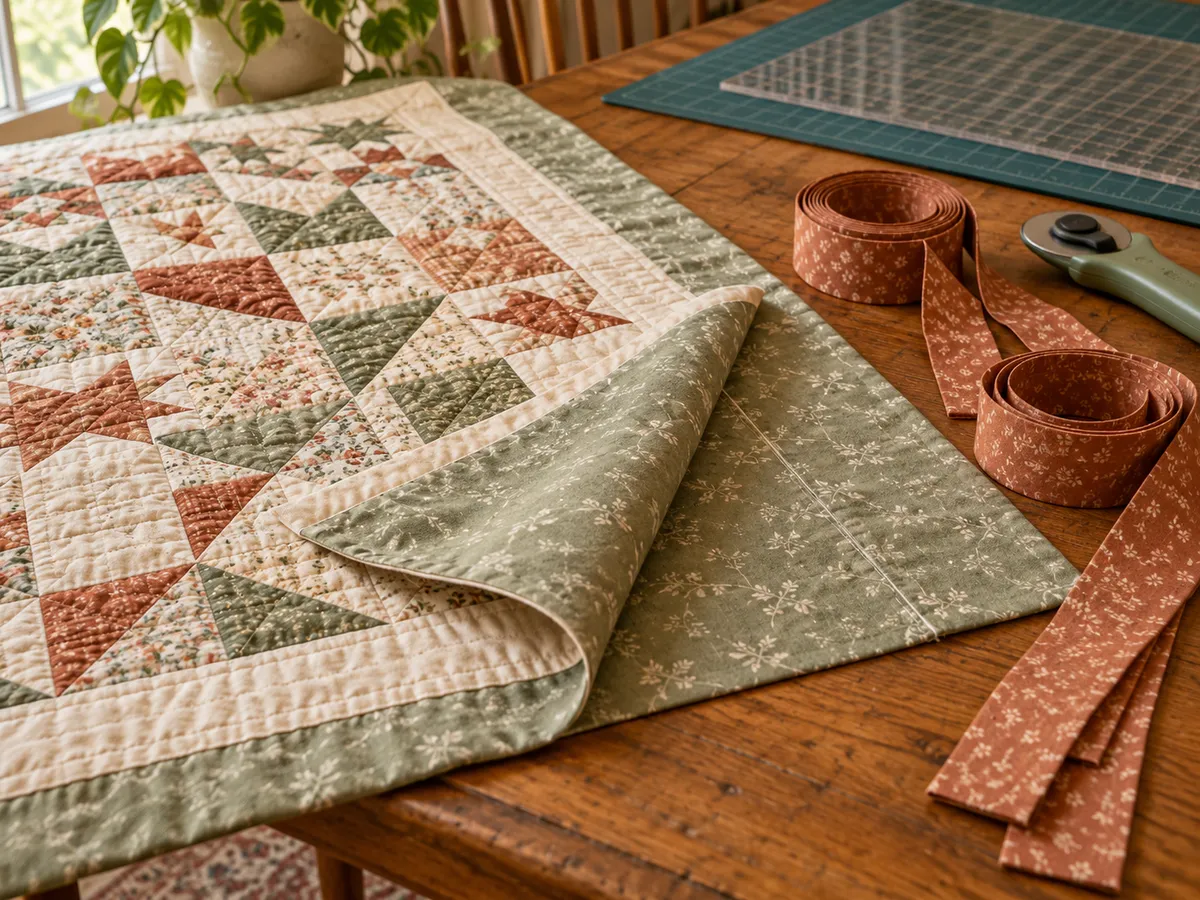
A 60" x 72" (152.4 x 182.9 cm) quilt needs 7 binding strips cut 2 1/2" wide, which is 1/2 yard, and 4 1/2 yards of backing with 40" usable width, seamed lengthwise. Two rules give those numbers: binding length is the perimeter plus 10", and the backing is 4" larger than the top on every side.
Each calculation is shown step by step below, with the seam direction that uses less fabric. Measure the finished top before you cut; the numbers here assume the quilt is the size the pattern says.
Key points
- Binding length = perimeter + 10". Strips = that length ÷ 40, rounded up.
- Binding yardage = strips × 2 1/2", rounded up to the next 1/8 yard.
- Backing size = quilt width + 8" by quilt length + 8" (4" extra on every side).
- Joined 40" panels with 1/2" seams cover 79" with two panels and 118" with three.
- Work out lengthwise and crosswise seams both ways; the cheaper one can differ by more than a yard.
Binding in four steps
Binding wraps the raw edge of the quilt, so its length depends on the perimeter. QUILTsocial adds 10" to the perimeter for joins and corners and cuts 2 1/2" strips; that is the convention used here. Strips are cut across the width of fabric, which this guide takes as 40" (101.6 cm) usable after the selvages are trimmed.
- Perimeter = 2 × width + 2 × length.
- Binding length = perimeter + 10".
- Strips = binding length ÷ 40, rounded up to a whole strip.
- Yardage = strips × 2.5", rounded up to the next 1/8 yard (4.5").
Worked example: binding a 60" x 72" quilt
The perimeter is 2 × 60 + 2 × 72 = 264". Adding 10" gives 274" (696 cm) of binding. Dividing by 40 gives 6.85, so you cut 7 strips, which join into 280" of binding. Seven strips 2 1/2" deep use 7 × 2.5 = 17.5" of fabric. The next 1/8-yard step above 17.5" is 18", so you buy 1/2 yard.
Missouri Star Quilt Co. adds 20" instead of 10", so its totals can be one strip higher on some sizes. Both methods use the same steps; the allowance is a choice about how much margin you want for joining strips.
| Quilt size | Perimeter + 10" | Strips (2 1/2") | Binding yardage |
|---|---|---|---|
| 36" × 48" | 178" | 5 | 3/8 yd |
| 50" × 60" | 230" | 6 | 1/2 yd |
| 60" × 72" | 274" | 7 | 1/2 yd |
| 60" × 80" | 290" | 8 | 5/8 yd |
| 80" × 90" | 350" | 9 | 5/8 yd |
| 90" × 108" | 406" | 11 | 7/8 yd |
How much bias tape from a yard of fabric?
About 518" (14.4 yards) of 2 1/2" continuous bias strip. A yard at 40" usable width is 36 × 40 = 1,440 square inches; divide by the 2.5" strip width for 576", then take off 10% for the two seams and the trimmed ends. For the 60" × 72" quilt above, which needs 274" of binding, a yard binds it with about 244" to spare, while a half yard (about 259") comes up 15" short. Where 1/2 yard does for straight-grain binding, plan on 5/8 yard for bias.
The chart below gives the three cuts most people have on hand. The full chart at 2 1/4" and 2 1/2", the square method for a known length and every assumption are in the bias tape guide linked under related guides.
| Fabric cut | Usable size | 2 1/2" bias tape |
|---|---|---|
| Fat quarter | 18" × 20" | about 129" (3.6 yd) |
| 1/2 yard | 18" × 40" | about 259" (7.2 yd) |
| 1 yard | 36" × 40" | about 518" (14.4 yd) |
Backing size: 4" extra on every side
The backing is cut larger than the top because quilting draws the layers in and because a longarm frame needs fabric to hold. Missouri Star Quilt Co. adds 8" to both the width and the length of the finished top, which is 4" on each side, and this guide uses the same allowance. Some longarm quilters ask for more, so check with yours before you buy.
For the 60" x 72" quilt, the backing must be 68" x 80" (172.7 x 203.2 cm). Both measurements are wider than one 40" width of fabric, so the backing has to be pieced from panels.
Joining panels: how much width each seam uses
Backing panels are joined with a 1/2" seam, so each seam takes up 1" of the total width. Two 40" panels give 40 + 40 − 1 = 79". Three panels give 40 × 3 − 2 = 118". In general, n panels cover 39 × n + 1 inches.
That gives two ways to seam a backing. With a lengthwise seam, the panels run the length of the quilt and are placed side by side to cover the width. With a crosswise seam, the panels run across the width and are stacked to cover the length. The quilt pattern generator on this site calculates both and picks the one that needs less fabric.
Worked example: backing a 60" x 72" quilt
Lengthwise seam: the backing width is 68", and two panels cover 79", so you need two panels, each 80" long. That is 2 × 80 = 160" of fabric. Rounded up to the next 1/8 yard, 160" becomes 162", or 4 1/2 yards.
Crosswise seam: now the panels must cover the 80" length. Two panels cover only 79", which is 1" short, so you need three panels, each 68" long: 3 × 68 = 204", which rounds up to 5 3/4 yards. The lengthwise seam wins by 1 1/4 yards. The 79" limit is easy to miss, which is why it pays to run both directions.
| Quilt size | Backing size | Cheaper seam | Backing yardage |
|---|---|---|---|
| 36" × 48" | 44" × 56" | Crosswise, 2 panels | 2 1/2 yd |
| 50" × 60" | 58" × 68" | Crosswise, 2 panels | 3 1/4 yd |
| 60" × 72" | 68" × 80" | Lengthwise, 2 panels | 4 1/2 yd |
| 80" × 90" | 88" × 98" | Crosswise, 3 panels | 7 3/8 yd |
| 90" × 108" | 98" × 116" | Crosswise, 3 panels | 8 1/4 yd |
What to check before you cut
Measure the finished top after it is pressed, not the size the pattern promised, because piecing often changes the size slightly. Measure the usable width of your backing fabric after prewashing; if it is less than 40", recalculate the panels. Ask your longarm quilter how much extra backing they need on each side. If the fabric has a one-way print, check that the seam direction you chose keeps the print the right way up.
Common questions
- Why 2 1/2 inch binding strips?
- A 2 1/2" strip folded in half makes a double-fold binding that suits most quilts. QUILTsocial cuts 2 1/2" strips in its method. If you prefer a narrower 2 1/4" binding, multiply the strip count by 2.25" instead.
- Can I use wide backing fabric instead of piecing?
- Yes. If the fabric is wider than the backing size, you need only one length: backing length plus a little for squaring, rounded up. Check the usable width of the wide fabric first.
- Why does a 1/2 inch backing seam use 1 inch of width?
- Each panel gives up 1/2" to the seam, and two panels meet at every seam, so 1" of the combined width disappears into each seam.
- Do I need extra backing for a longarm quilter?
- Many longarm quilters ask for at least 4" on every side, and some ask for more. Confirm the number with your quilter before buying, because it can change the panel count.
- How much bias tape from a yard of fabric?
- About 518" (14.4 yards) of 2 1/2" strip from a yard with 40" usable width, or about 576" (16 yards) at 2 1/4", after a 10% allowance for seams and trimmed ends. A fat quarter gives about 129" and a half yard about 259" at 2 1/2".
About this page
Written and reviewed by Claire, Editor, Needle Nook. Last reviewed . General craft guidance; check your own gauge and measurements before cutting or stitching.
Facts on this page follow these references:
- The Formula for Calculating the Necessary Yardage for Binding Your Quilt ↗QUILTsocial
- How to Calculate Quilt Backing Yardage ↗Missouri Star Quilt Co.