Quilt Batting Sizes Chart: What Size to Buy
Batting should be 8" wider and longer than the quilt top. Packaged sizes from crib 45" × 60" to king 120" × 120", the largest top each covers, and roll yardage.
https://needlenook.app/learn/quilt-batting-sizes-chart
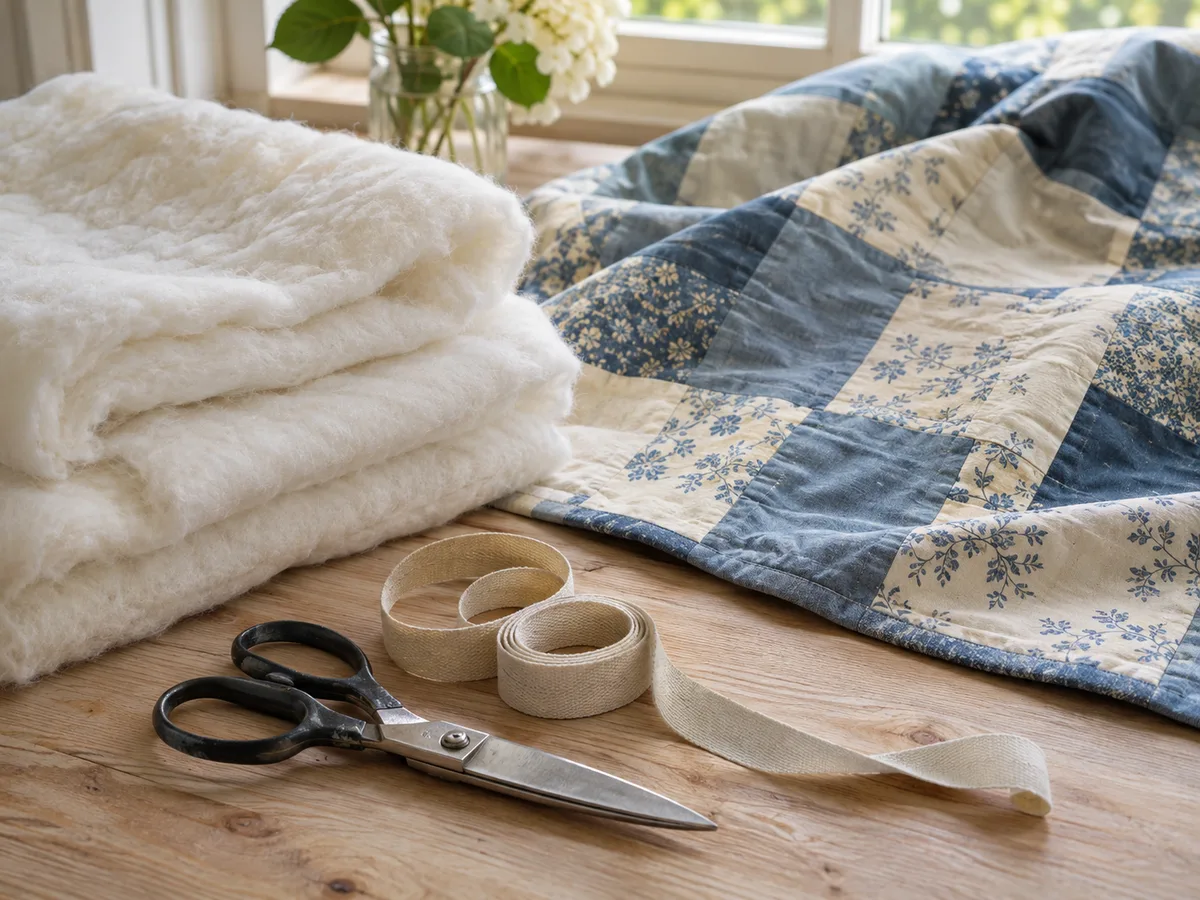
Buy batting 8" wider and 8" longer than the quilt top: 4" extra on every side. A 50" × 65" throw top needs 58" × 73", so the smallest common package that covers it is twin (72" × 90"); the 60" × 60" throw package is too short.
The charts below assume the common packaged sizes (crib 45" × 60", throw 60" × 60", twin 72" × 90", full 81" × 96", queen 90" × 108", king 120" × 120") and the same 4" per side that the quilt generator uses for backing and batting. Brands differ by an inch or two, so read the label and measure your finished top before you buy.
Key points
- Batting size = (top width + 8") × (top length + 8"), which is 4" beyond the top on every side.
- Largest top each package covers at 4" per side: crib 37" × 52", throw 52" × 52", twin 64" × 82", full 73" × 88", queen 82" × 100", king 112" × 112".
- A 90" × 108" queen top is the same size as a queen package, so it leaves no margin; plan king batting or 2 3/4 yards of a 120" roll.
- From a roll, buy the length of the side that does not fit across the roll, plus 8", rounded up to the next 1/8 yard.
- Cotton and cotton-blend batting can shrink about 3–5% in the first wash (The Fabric Company), so measure after any prewash.
The rule: quilt top plus 8" each way
The Fabric Company gives the formula as (quilt top width + 8") × (quilt top length + 8"), a 4" buffer on every side. The buffer covers the draw-up as the three layers are quilted together, which can take an inch or more from each direction, and leaves room to square the quilt and trim clean edges afterwards. Quilt Batting, a batting shop, gives the same 4" per side as its own safety margin.
Missouri Star's backing calculator offers 4" per side as standard for machine quilting, 2" for hand quilting or a small project and 6" as a longarm quilter's preference, and notes that most longarm quilters ask for 4" to 6" of extra backing all the way around. This guide plans batting with the same 4" as the backing; if your longarm quilter asks for more, use their figure in the formula.
- Measure the finished top: 50" × 65" in this example.
- Add 8" to the width: 50 + 8 = 58".
- Add 8" to the length: 65 + 8 = 73".
- Batting needed: 58" × 73". The smallest package that covers it is twin, 72" × 90".
Packaged batting sizes and the largest top each one covers
Pre-cut batting is sold folded in packages named after bed sizes. Both batting sources list crib 45" × 60", twin 72" × 90", queen 90" × 108" and king 120" × 120"; The Fabric Company adds a 60" × 60" throw and Quilt Batting adds full 81" × 96" and a 96" × 108" queen option. The third column subtracts 8" from each side of the package, so it is the largest quilt top that still gets 4" all round.
| Package | Package size | Largest top at 4" per side | Typical use |
|---|---|---|---|
| Crib | 45" × 60" | 37" × 52" | Baby and crib quilts |
| Throw | 60" × 60" | 52" × 52" | Square throws and wall quilts |
| Twin | 72" × 90" | 64" × 82" | Most throws and lap quilts |
| Full / double | 81" × 96" | 73" × 88" | Twin quilts and long throws |
| Queen | 90" × 108" | 82" × 100" | Full-size quilts |
| King | 120" × 120" | 112" × 112" | Queen and king quilts |
What size batting for each quilt size
The quilt sizes below are the common sizes in the quilt generator. Each row adds 8" each way, picks the smallest package that covers the result in either direction, and gives the length to buy from a roll as a second choice. A dash means the batting is wider than that roll in both directions.
Two rows differ from the published charts. Both sources pair a 70" × 90" twin top with twin batting and a 90" × 108" queen top with queen batting; The Fabric Company lists that queen pairing as 0" to 9" per side. At a full 4" per side those tops need the next package up. If you quilt on a domestic machine and accept 1" at the ends, the matching package works; if a longarm quilter is doing the work, ask before you buy.
| Quilt top | Batting needed | Smallest package | From a 96" roll | From a 120" roll |
|---|---|---|---|---|
| Baby 36" × 52" | 44" × 60" | Crib | 1 1/4 yd | 1 1/4 yd |
| Throw 50" × 65" | 58" × 73" | Twin | 1 5/8 yd | 1 5/8 yd |
| Twin 70" × 90" | 78" × 98" | Queen | 2 3/4 yd | 2 1/4 yd |
| Full 85" × 108" | 93" × 116" | King | 3 1/4 yd | 2 5/8 yd |
| Queen 90" × 108" | 98" × 116" | King | — | 2 3/4 yd |
| King 108" × 108" | 116" × 116" | King | — | 3 1/4 yd |
Buying from a roll
Quilt Batting lists three common roll widths: 48", 96" and 120". One side of the batting you need has to fit across the roll; the other side is the length you buy. Their formula is (quilt length + 8") ÷ 36 = yards. This guide also tries the quilt turned the other way and rounds up to the next 1/8 yard, the same rounding the quilt generator uses for fabric.
Their own example is a 92" × 100" top. With 8" added it needs 100" × 108", which is too wide for a 96" roll, so it comes from the 120" roll. Cut with the 100" side across the roll, the length is 108", exactly 3 yards. Turned so the 108" side runs across the roll, the length drops to 100", which rounds up to 2 7/8 yards. Either way works; the turned cut saves 1/8 yard.
- 48" roll: baby quilts and small projects. A 36" × 52" baby top needs 44" × 60", so 60" of length, 1 3/4 yards.
- 96" roll: throws and most twin quilts.
- 120" roll: queen and king quilts without piecing the batting.
Worked example: a 60" × 72" quilt
A 60" × 72" quilt needs 68" × 80" of batting. The twin package (72" × 90") covers it with 4" to spare across and 10" along the length. From a 96" roll, put the 80" side across the roll and buy 68" of length, which rounds up to 2 yards. A 48" roll is too narrow in both directions.
The same quilt needs 274" of binding, which is 7 strips of 2 1/2" and 1/2 yard of fabric, and 4 1/2 yards of 40"-wide backing in two panels, as worked out in the binding and backing guide. The quilt generator lists all three for your own quilt.
What to check before you buy
Measure the finished top through the middle and along both edges, in each direction, and use the largest number. Read the package label rather than the size name, because brands differ by an inch or two. If you plan to prewash cotton or cotton-blend batting, allow for the 3–5% shrinkage The Fabric Company mentions, or measure again after washing. Confirm the margin your longarm quilter wants before you cut anything, and keep the trimmed strips: they are useful for small projects.
Common questions
- What size batting do I need for a queen size quilt?
- A 90" × 108" queen top needs 98" × 116" of batting at 4" per side. That is larger than the queen package (90" × 108"), so buy a king package (120" × 120") or 2 3/4 yards from a 120" roll. The queen package matches the top exactly and leaves no margin.
- What size batting for a throw quilt?
- A 50" × 65" throw needs 58" × 73". The 60" × 60" throw package covers tops up to 52" × 52" only, so the smallest package that fits is twin (72" × 90"), or 1 5/8 yards from a 96" roll.
- How much bigger than the quilt top should batting be?
- The usual rule is 4" on every side, 8" in total each way. Missouri Star's backing calculator lists 2" per side for hand quilting or a small project and 6" as a longarm quilter's preference; use your quilter's figure if they give one.
- Is crib batting big enough for a baby quilt?
- For a 36" × 52" baby quilt, yes: it needs 44" × 60" and crib batting is 45" × 60". Crib batting covers tops up to 37" × 52" with 4" per side; a larger baby quilt needs twin batting or a cut from a roll.
About this page
Written and reviewed by Claire, Editor, Needle Nook. Last reviewed . General craft guidance; check your own gauge and measurements before cutting or stitching.
Facts on this page follow these references:
- A Quilter's Guide to Quilting Batting Sizes for Every Project ↗The Fabric Company
- The Essential Guide to Quilt Batting Sizes ↗Quilt Batting (quiltbatting.shop)
- How to Calculate Quilt Backing Yardage ↗Missouri Star Quilt Co.