US vs UK Crochet Terms (and How to Read a Pattern)
A US to UK crochet terms chart (sc = UK dc, dc = UK tr) plus how to read a pattern: abbreviations, turning chains, repeats and stitch counts.
https://needlenook.app/learn/us-vs-uk-crochet-terms
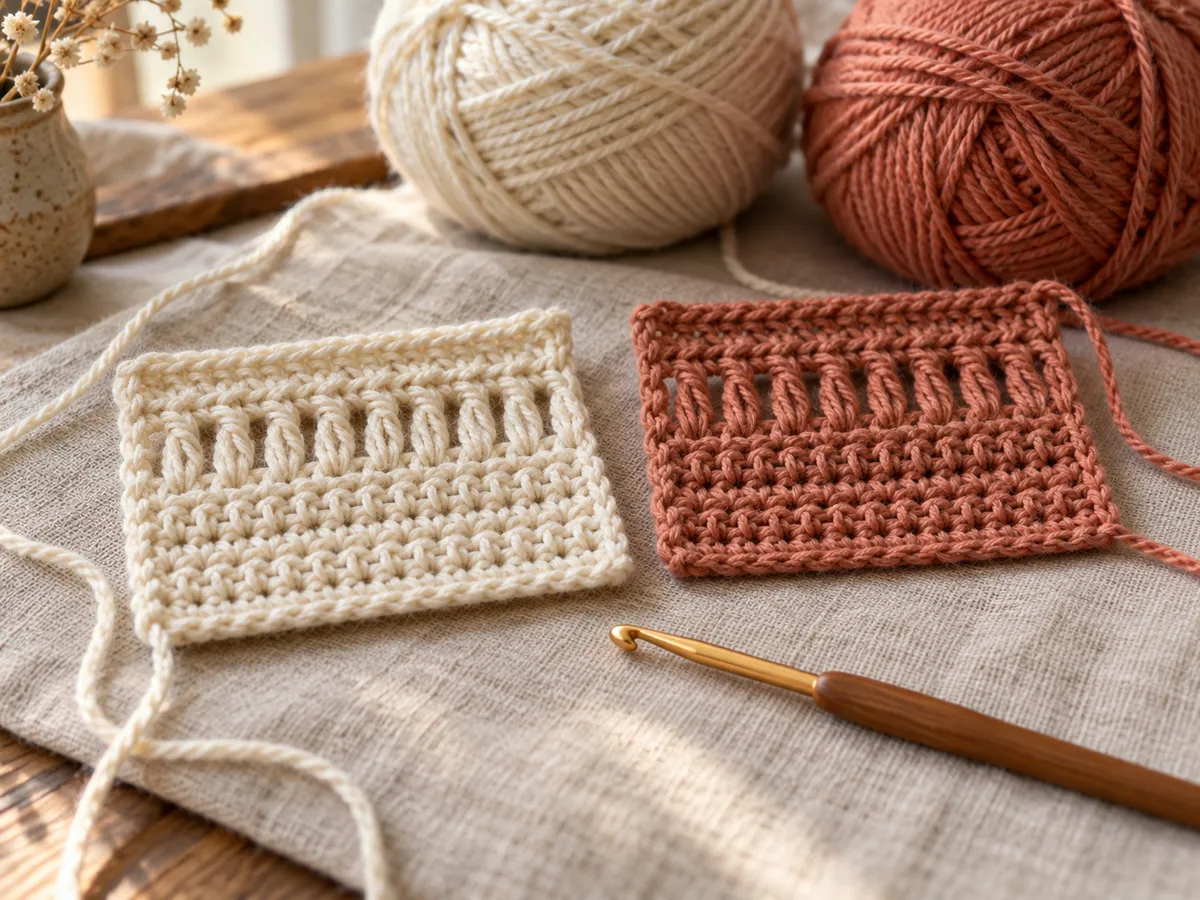
US and UK crochet use the same stitches, but the names are shifted by one. A US single crochet (sc) is a UK double crochet (dc), and a US double crochet is a UK treble (tr). The same abbreviation can mean a different stitch on each side of the Atlantic, so check which terms a pattern uses before you start.
Below is a side-by-side chart, then a walk through one pattern line at a time: abbreviations, foundation and turning chains, repeats, and the stitch counts in parentheses.
Key points
- US sc = UK dc, US hdc = UK htr, US dc = UK tr, US tr = UK dtr.
- Look for "single crochet" in a pattern: it appears only in US terms, so it tells you which system is used.
- Repeats use asterisks (*) and brackets ([ ] 4 times); parentheses can mean a group worked into one stitch.
- A number after a colon or in parentheses at the end of a row, such as (14 sc), is a stitch count, not an instruction.
- In single crochet the turning ch 1 is not a stitch; in double crochet the ch 3 usually counts as the first dc.
US to UK crochet terms chart
The Craft Yarn Council lists the US and UK names side by side. The pattern is a shift of one: each US stitch name moves up one step in UK terms, and the US half double crochet (hdc) becomes the UK half treble (htr). LoveCrafts adds the small vocabulary differences, such as skip and miss.
| US term | US abbr. | UK term | UK abbr. |
|---|---|---|---|
| chain | ch | chain | ch |
| slip stitch | sl st | slip stitch | ss |
| single crochet | sc | double crochet | dc |
| half double crochet | hdc | half treble | htr |
| double crochet | dc | treble | tr |
| treble (triple) crochet | tr | double treble | dtr |
| skip | sk | miss | (written out) |
| yarn over | yo | yarn over hook | yoh |
| gauge | (written out) | tension | (written out) |
How to tell which terms a pattern uses
Start with the pattern notes; many designers state "US terms" or "UK terms" near the top. If they do not, scan the stitch list. "Single crochet" or "sc" appears only in US patterns, and "half treble" or "htr" appears only in UK patterns. A pattern that lists dc and tr but no sc or htr is ambiguous, so look at the stitch key, the photos, or the yarn and hook sizes before you begin.
Some UK patterns write "yarn round hook (yrh)" instead of yoh; both describe wrapping the yarn over the hook. The crochet pattern generator on this site writes its patterns in US terms, so use the chart above if you think in UK terms.
Abbreviations: read the key first
Patterns abbreviate everything to save space. The Craft Yarn Council master list covers the common ones, and designers define any special abbreviations at the start of the pattern. A few that appear in almost every pattern:
- ch = chain; sl st = slip stitch; st(s) = stitch(es)
- inc = increase (work 2 stitches into one stitch)
- dec = decrease; sc2tog = single crochet 2 stitches together
- rep = repeat; rnd = round; rem = remaining
- BLO / FLO = back loop only / front loop only
- RS / WS = right side / wrong side
Foundation chains and turning chains
The foundation chain is longer than the number of stitches you want, because the first stitch skips some chains. For N single crochet, chain N + 1 and work the first sc in the 2nd chain from the hook. For N half double crochet, chain N + 2 and work the first hdc in the 3rd chain from the hook. For N double crochet, chain N + 2 and work the first dc in the 4th chain from the hook; the 3 skipped chains count as the first dc.
The Craft Yarn Council example makes this concrete: "Ch 15. Row 1: Sc in 2nd ch from hook and in each ch across: 14 sc." For double crochet, "Ch 17. Row 1: Dc in 4th ch from hook and in each ch across: 15 dc." The turning chain at the start of each later row follows the same idea: ch 1 for sc (not a stitch), ch 2 for hdc, and ch 3 for dc (counts as the first dc). Conventions for hdc vary between designers, so follow the pattern; the generator on this site treats the hdc ch 2 as not counting.
| Stitch | Foundation chain for N sts | First stitch goes in | Turning chain |
|---|---|---|---|
| sc (UK dc) | N + 1 | 2nd ch from hook | ch 1, does not count |
| hdc (UK htr) | N + 2 | 3rd ch from hook | ch 2, does not count here |
| dc (UK tr) | N + 2 | 4th ch from hook | ch 3, counts as first dc |
Repeats: asterisks, brackets and parentheses
An asterisk marks the start of a repeat. "Dc in next 3 sts; *ch 1, skip next st, dc in next st; rep from * across" means you work the steps after the asterisk again and again to the end of the row. A pattern may also put asterisks on both sides of a group and say "rep from * to *".
Brackets give a repeat count: "[sk next dc, shell in next dc] 4 times" means work that pair of steps four times, then move on. Parentheses are sometimes used the same way, but they also mark a group of stitches worked into a single stitch, such as "in next dc work (2 dc, ch 3, 2 dc)". Read the sentence around them to tell which meaning applies.
Stitch counts in parentheses
At the end of a row or round, patterns often state how many stitches you should have. The Craft Yarn Council shows three common styles: ": 14 sc.", "(14 sc)." and "—14 sc." All three mean the same thing. They are a check, not an instruction, so count your stitches and compare. If the number is off, look first at the turning chain and the last stitch of the row, which are the easiest to miss or add.
Reading one row from start to finish
Take "Row 2 (US): Ch 3 (counts as dc), dc in next st, *ch 1, sk next st, dc in next 2 sts; rep from * across: 16 dc." In words: chain 3 and treat it as the first double crochet, work a double crochet in the next stitch, then repeat the steps after the asterisk (chain 1, skip a stitch, double crochet in each of the next 2 stitches) until the row ends. You should finish with 16 double crochets. In UK terms the same row reads "ch 3 (counts as tr), tr in next st, *ch 1, miss next st, tr in next 2 sts; rep from * across: 16 tr."
Common questions
- Is UK double crochet the same as US single crochet?
- Yes. The Craft Yarn Council chart pairs the US single crochet (sc) with the UK double crochet (dc). The stitch is worked the same way; only the name is different.
- What does "sc in 2nd ch from hook" mean?
- Do not count the loop on the hook. Count the chains away from the hook, skip the first one, and work the single crochet into the second chain.
- Does the turning chain count as a stitch?
- In single crochet, no. In double crochet, the ch 3 usually counts as the first stitch. For other stitches, follow the pattern notes, because designers handle half double crochet in different ways.
- What is the difference between [ ] and ( ) in a crochet pattern?
- Brackets usually tell you to repeat a group a stated number of times. Parentheses can do the same, or they can mean a group of stitches all worked into one stitch or space, such as a shell.
About this page
Written and reviewed by Ivy, Editor, Needle Nook. Last reviewed . General craft guidance; check your own gauge and measurements before cutting or stitching.
Facts on this page follow these references:
- Crochet Abbreviations Master List ↗Craft Yarn Council
- How to Read a Crochet Pattern ↗Craft Yarn Council
- UK vs. US Crochet Terms ↗LoveCrafts