Crochet Hook Sizes Chart: mm to US and UK
Crochet hook sizes side by side: millimeters, US letter and number sizes from the Craft Yarn Council, old UK numbers, and the hook range for every yarn weight.
https://needlenook.app/learn/crochet-hook-sizes-chart
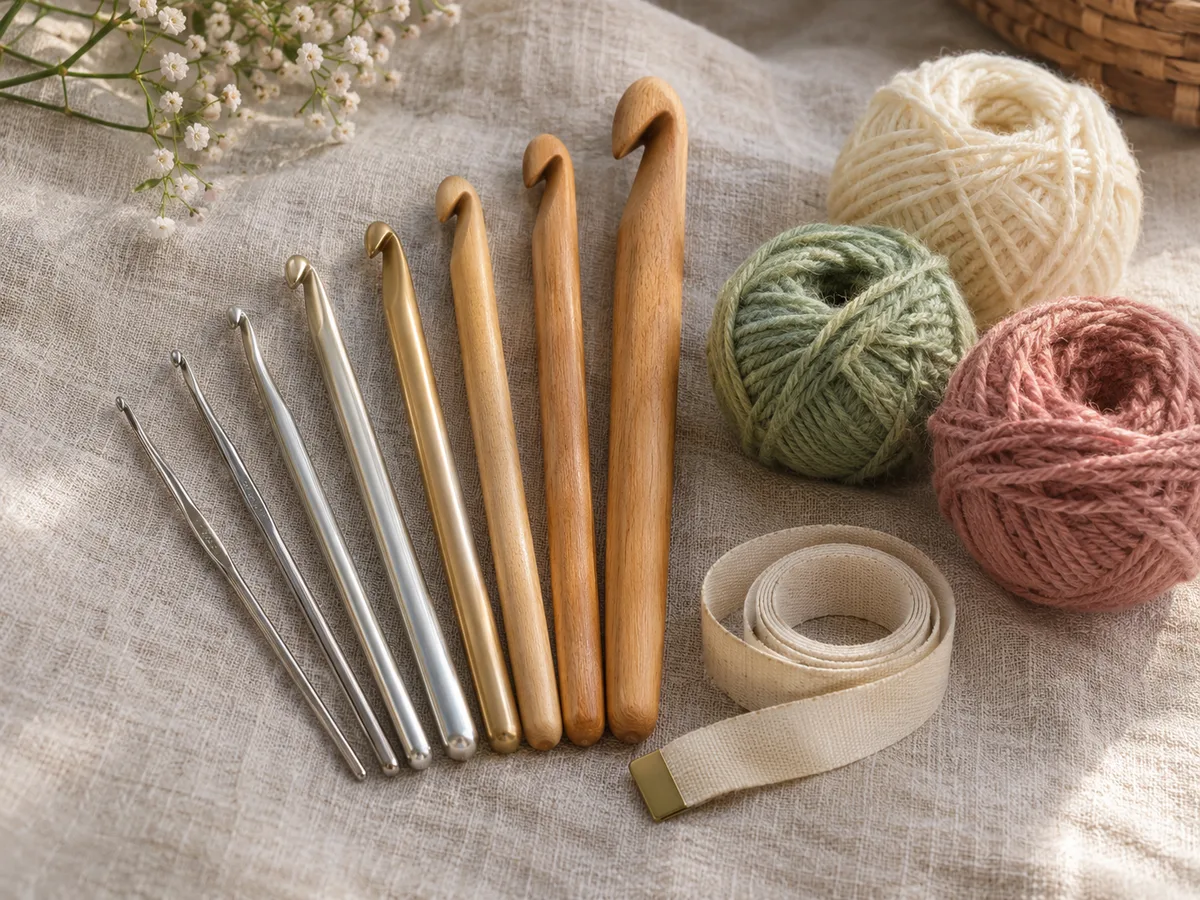
A 5 mm hook is a US H-8 and an old UK 6; a 4 mm hook is a US G-6 and a UK 8. Millimeters (mm) are the one size that means the same thing everywhere, so the chart below is sorted by mm, with the US letter-and-number names from the Craft Yarn Council (CYC) and the UK imperial numbers from DMC beside them.
The UK scale runs the other way: a bigger UK number is a thinner hook. Example: a pattern that asks for a UK 4 wants a 6 mm hook, which a US pattern calls a J-10. A second chart pairs each CYC yarn weight, from 0 lace to 7 jumbo, with its hook range, and a short section covers steel hooks for thread. Check the mm stamped on your hook before you trust any letter.
Key points
- Millimeters are the reliable size; the CYC says US letters and numbers vary between makers.
- Common pairs: 4 mm = G-6 = UK 8; 5 mm = H-8 = UK 6; 5.5 mm = I-9 = UK 5; 6 mm = J-10 = UK 4; 6.5 mm = K-10 1/2.
- Old UK numbers run backwards: UK 13 is 2.25 mm and UK 4 is 6 mm (DMC).
- Weight 4 medium (worsted) yarn takes a 5.5 to 6.5 mm hook; weight 5 bulky takes 6.5 to 9 mm (CYC).
- Steel hooks for thread are numbered in reverse too: 14 is the smallest at 0.9 mm, 00 the largest at 2.7 mm.
Crochet hook sizes chart: 2.25 to 6.5 mm
The mm and US columns follow the Craft Yarn Council's hook chart. The UK column follows DMC's conversion chart, which lists the old imperial numbers down to 6 mm and leaves larger hooks blank; a dash means the source gives no size at that mm. DMC's own US column differs from the CYC in two places (it labels 4.5 mm as G/7 and pairs C/2 with 2.5 mm), which is exactly why both charts say to go by the mm.
| mm | US (CYC) | UK (DMC) |
|---|---|---|
| 2.25 mm | B-1 | 13 |
| 2.5 mm | — | 12 |
| 2.75 mm | C-2 | — |
| 3 mm | — | 11 |
| 3.25 mm | D-3 | 10 |
| 3.5 mm | E-4 | 9 |
| 3.75 mm | F-5 | 9 |
| 4 mm | G-6 | 8 |
| 4.25 mm | G | — |
| 4.5 mm | 7 | 7 |
| 5 mm | H-8 | 6 |
| 5.25 mm | I | — |
| 5.5 mm | I-9 | 5 |
| 5.75 mm | J | — |
| 6 mm | J-10 | 4 |
| 6.5 mm | K-10 1/2 | — |
Large hooks: 7 to 30 mm
Above 6.5 mm the letters start to double up: the CYC gives M/N for 9 mm, N/P for 10 mm and P/Q for 15 mm, and three different mm sizes share the letter Q. Three sizes (7 mm, 12 mm and 2.5 mm in the chart above) have no US name at all. Big hooks are sold by mm almost everywhere, so a pattern that names only a letter is the one to double-check.
| mm | US (CYC) |
|---|---|
| 7 mm | — |
| 8 mm | L-11 |
| 9 mm | M/N-13 |
| 10 mm | N/P-15 |
| 11.5 mm | P-16 |
| 12 mm | — |
| 15 mm | P/Q |
| 15.75 mm | Q |
| 16 mm | Q |
| 19 mm | S |
| 25 mm | T/U/X |
| 30 mm | T/X |
Which hook for which yarn weight
The CYC Standard Yarn Weight System pairs each weight with a hook range and a gauge. Gauge is given in single crochet (sc) stitches to 4", the stitch UK patterns call double crochet (dc). The council labels the table "guidelines only": the pattern's gauge and your own tension pick the final hook. Lace weight is the exception, because it is usually worked on larger hooks for open patterns, so the CYC says to follow the gauge in the pattern.
| CYC weight | Yarn types | sc per 4" | Hook (mm) | US hook |
|---|---|---|---|---|
| 0 Lace | Fingering, 10-count crochet thread | 32–42 dc | Steel 1.6–1.4; regular 2.25 | Steel 6–8; B-1 |
| 1 Super fine | Sock, fingering, baby | 21–32 | 2.25–3.5 | B-1 to E-4 |
| 2 Fine | Sport, baby | 16–20 | 3.5–4.5 | E-4 to 7 |
| 3 Light | DK, light worsted | 12–17 | 4.5–5.5 | 7 to I-9 |
| 4 Medium | Worsted, afghan, aran | 11–14 | 5.5–6.5 | I-9 to K-10 1/2 |
| 5 Bulky | Chunky, craft, rug | 8–11 | 6.5–9 | K-10 1/2 to M-13 |
| 6 Super bulky | Super bulky, roving | 7–9 | 9–15 | M-13 to Q |
| 7 Jumbo | Jumbo, roving | 6 and fewer | 15 and larger | Q and larger |
Steel hooks for thread
Steel hooks are the small ones used with lace-weight yarn and crochet thread, and the CYC notes they are numbered in reverse: the higher the number, the smaller the hook. The smallest is a 14 at 0.9 mm and the largest a 00 at 2.7 mm. Because the steel numbers and the regular numbers overlap (a steel 7 and an aluminum 7 are nowhere near the same size), read the mm on a thread pattern too.
One example row in both languages
A UK pattern might read: "Using a 4 mm (UK 8) hook, ch 21, 1 dc into 2nd ch from hook, 1 dc into each ch to end (20 sts)." The same row in US terms: "With a G-6 (4 mm) hook, ch 21, sc in 2nd ch from hook and in each ch across (20 sc)." Here ch is chain, dc in UK terms is the stitch US terms call sc (single crochet), and sts is stitches. The hook is the one thing both versions agree on, as long as you read it in mm.
What to check before you start
Look for the mm stamped on the hook and ignore the letter if the two disagree. Work a gauge swatch in the pattern's stitch and compare it with the stated gauge; go up a hook if your swatch is small and down if it is large. If you have inherited hooks with no marking, DMC mentions a hook sizing tool, a small gauge with holes, that tells you the mm. And if a vintage UK pattern names only a number, convert it from the chart, remembering that the scale runs backwards.
Common questions
- What size is a 5 mm crochet hook in US and UK sizes?
- A 5 mm hook is a US H-8 on the Craft Yarn Council chart and an old UK 6 on the DMC chart. It sits just below the weight 4 (worsted) range, which starts at 5.5 mm.
- What mm is a UK size 8 crochet hook?
- UK 8 is 4 mm, which US patterns call G-6. The UK numbers run the other way from mm: UK 9 is 3.5 or 3.75 mm and UK 7 is 4.5 mm.
- Is a US G hook 4 mm or 4.25 mm?
- The CYC lists G-6 at 4 mm and a plain G at 4.25 mm, and makers differ. Use whichever your gauge swatch matches, and buy by mm when it matters.
- Why do some sizes have no US letter?
- The CYC chart has blank US cells at 2.5 mm, 7 mm and 12 mm, and DMC has none above 6 mm for the UK. Nothing is wrong with those hooks; they were added to ranges after the letter system was set, so they are sold by mm alone.
About this page
Written and reviewed by Ivy, Editor, Needle Nook. Last reviewed . General craft guidance; check your own gauge and measurements before cutting or stitching.
Facts on this page follow these references:
- Hooks and Needles: Size Conversion Chart ↗Craft Yarn Council
- Understanding Crochet Hook Sizes ↗DMC
- Standard Yarn Weight System ↗Craft Yarn Council