Crochet Beanie Size Chart and Crown Math
Crochet beanie sizes from head circumference: subtract negative ease, divide by pi for crown diameter, then work even to the hat height. Chart included.
https://needlenook.app/learn/crochet-beanie-size-chart
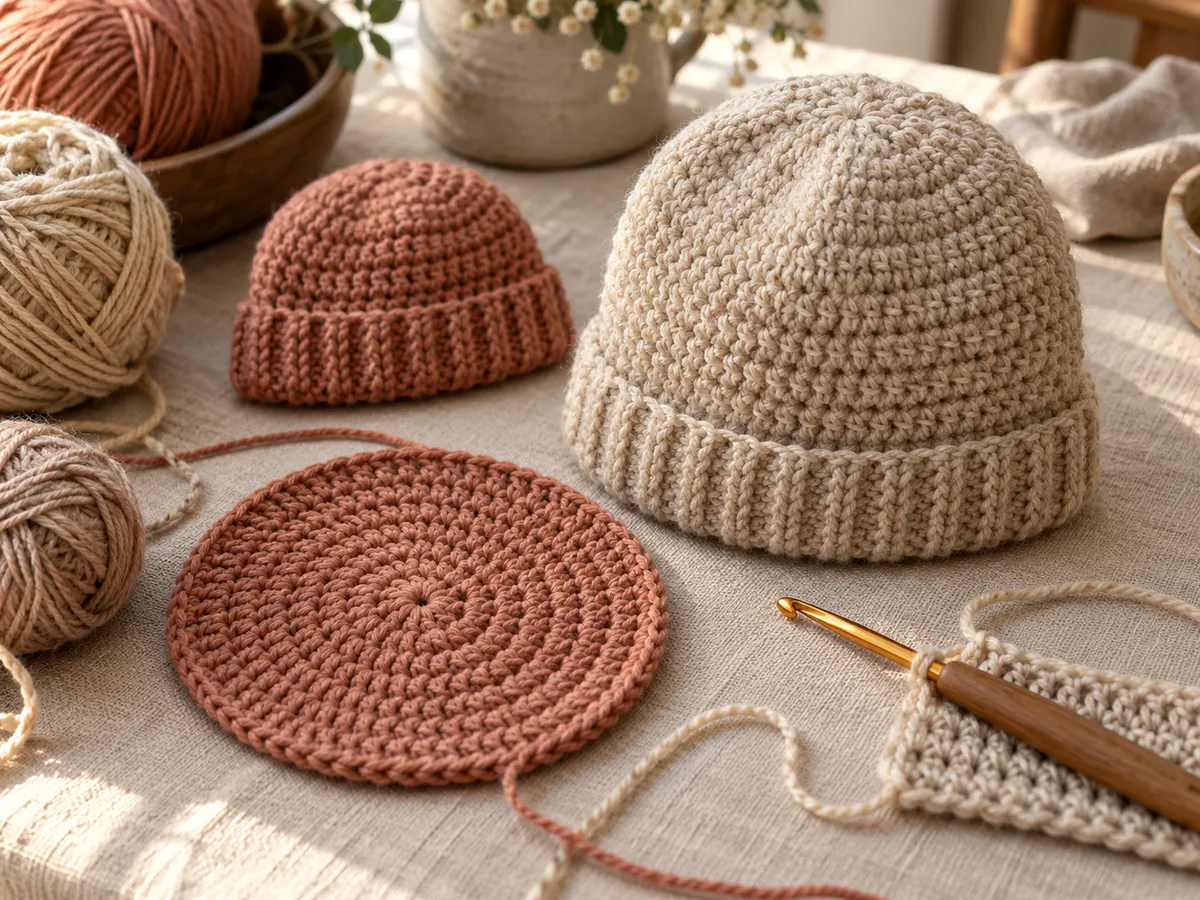
Size a beanie from the head. Hat circumference = head circumference minus negative ease. The flat crown should measure that circumference divided by pi (3.14) across. For a 22" (55.9 cm) head with 2" of negative ease, the hat is 20" around and the crown circle is about 6.37" (16.2 cm) wide.
The sections give head sizes from the Craft Yarn Council, the matching crown diameters, and the steps for a top-down hat. Check the crown with a tape measure as you go.
Key points
- Hat circumference = head circumference − negative ease; this site defaults to 2" of ease.
- Crown diameter ≈ hat circumference ÷ 3.14.
- Stitches in the last crown round = hat circumference × your stitches per inch.
- After the crown, work even rounds with no increases until the hat reaches the height you measured.
- Check the crown with a tape measure as it grows, not only by counting.
Start with the head measurement
Measure around the head just above the ears and across the forehead, where the hat will sit. If you cannot measure, the Craft Yarn Council publishes typical head circumferences by age group: 21–23" (53–58.5 cm) for an adult woman and 22–24" (56–61 cm) for an adult man, with smaller ranges for babies, toddlers, children and tweens. A real measurement is always better than a chart, because heads within one age group vary.
Negative ease: why the hat is smaller than the head
A beanie is meant to hug the head, so it is made smaller than the head and stretches to fit. That difference is called negative ease. The crochet pattern generator on this site defaults to 2" (5.1 cm) of negative ease, so a 22" head gets a 20" hat. Stiffer stitches stretch less, so you may want less ease for a dense fabric. For very small heads, 2" is a larger share of the total, so consider reducing it.
Crown math: circumference divided by pi
A top-down beanie starts as a flat circle. The edge of that circle becomes the hat circumference, so its diameter must be the circumference divided by pi. Using 3.14, a 20" hat needs a crown about 20 ÷ 3.14 = 6.37" (16.2 cm) across. Lay the crown flat and measure straight through the center to check it.
The table applies 2" of negative ease to the Craft Yarn Council head ranges. Every figure is subtraction and division by 3.14, so you can redo it for your own measurement or ease.
| Size (CYC) | Head circumference | Hat (−2" ease) | Crown diameter |
|---|---|---|---|
| Baby | 14–16" (35.5–40.5 cm) | 12–14" | 3.82–4.46" (9.7–11.3 cm) |
| Toddler | 16–18" (40.5–46 cm) | 14–16" | 4.46–5.10" (11.3–12.9 cm) |
| Child | 18–20" (45.5–51 cm) | 16–18" | 5.10–5.73" (12.9–14.6 cm) |
| Tween | 20–22" (51–56 cm) | 18–20" | 5.73–6.37" (14.6–16.2 cm) |
| Adult woman | 21–23" (53–58.5 cm) | 19–21" | 6.05–6.69" (15.4–17.0 cm) |
| Adult man | 22–24" (56–61 cm) | 20–22" | 6.37–7.01" (16.2–17.8 cm) |
Turning inches into stitches
Make a gauge swatch in the stitch you will use and count stitches per inch. Multiply by the hat circumference to get the stitch count for the last crown round. For example, if your swatch shows 3 stitches per inch, a 20" hat needs 20 × 3 = 60 stitches around.
Next, grow a flat circle to that count. A flat crown adds the same number of stitches every round. If you start with 10 stitches and add 10 per round, the counts are 10, 20, 30, 40, 50 and 60, so the crown is finished after round 6. If your target is not a multiple of the step, stop at the nearest round and adjust by a few stitches on the next round.
Top-down steps
Here is the crown math in working order, from tape measure to finished hat.
- Measure the head and choose the negative ease.
- Hat circumference = head − ease.
- Target crown diameter = hat circumference ÷ 3.14.
- Target stitch count = hat circumference × stitches per inch.
- Increase evenly each round until you reach the target count.
- Check that the flat crown measures close to the target diameter.
- Work even rounds until the hat reaches the measured height.
- Add a brim or edging if you want one, then fasten off.
Checking as you go
Place a marker in the first stitch of each round and move it up, as Lion Brand advises for any work in the round. Count at the end of every increase round. Then lay the crown flat: if it ruffles, you have too many stitches for its size; if it cups upward, too few. When the crown reaches its target, hold a tape measure around the first even round and compare it with the hat circumference.
For height, measure the person from the crown of the head down to where the hat should end, or measure a hat that already fits. Keep working even rounds until the hat reaches that height from the center of the crown.
Common questions
- How much negative ease should a crochet beanie have?
- This site defaults to 2", which gives a snug fit for stretchy stitches. Use less for dense stitches that do not stretch much, or for small children where 2" is a large share of the total.
- How do I calculate the crown diameter of a hat?
- Divide the hat circumference by pi. With 3.14, a 20" hat needs a crown about 6.37" (16.2 cm) across, and a 19" hat needs about 6.05" (15.4 cm).
- What is the average adult head circumference for a hat?
- The Craft Yarn Council chart lists 21–23" (53–58.5 cm) for an adult woman and 22–24" (56–61 cm) for an adult man. Measure the wearer when you can.
- Why does my crown ruffle or cup?
- Ruffles mean too many stitches for the circle; cupping means too few. Check your gauge and make sure each round adds the same number of evenly spaced increases.
About this page
Written and reviewed by Lucy, Editor, Needle Nook. Last reviewed . General craft guidance; check your own gauge and measurements before cutting or stitching.
Facts on this page follow these references:
- Head Circumference Chart ↗Craft Yarn Council
- Crochet Abbreviations Master List ↗Craft Yarn Council
- What Is Amigurumi Crochet: a Beginner's Guide ↗Lion Brand Yarn