Crochet Magic Ring and Amigurumi Ball Pattern
Start a crochet ball with 6 sc in a magic ring, add 6 stitches per round (12, 18, 24), work even, then decrease 6 per round back to 6 and close.
https://needlenook.app/learn/crochet-magic-ring-amigurumi-ball
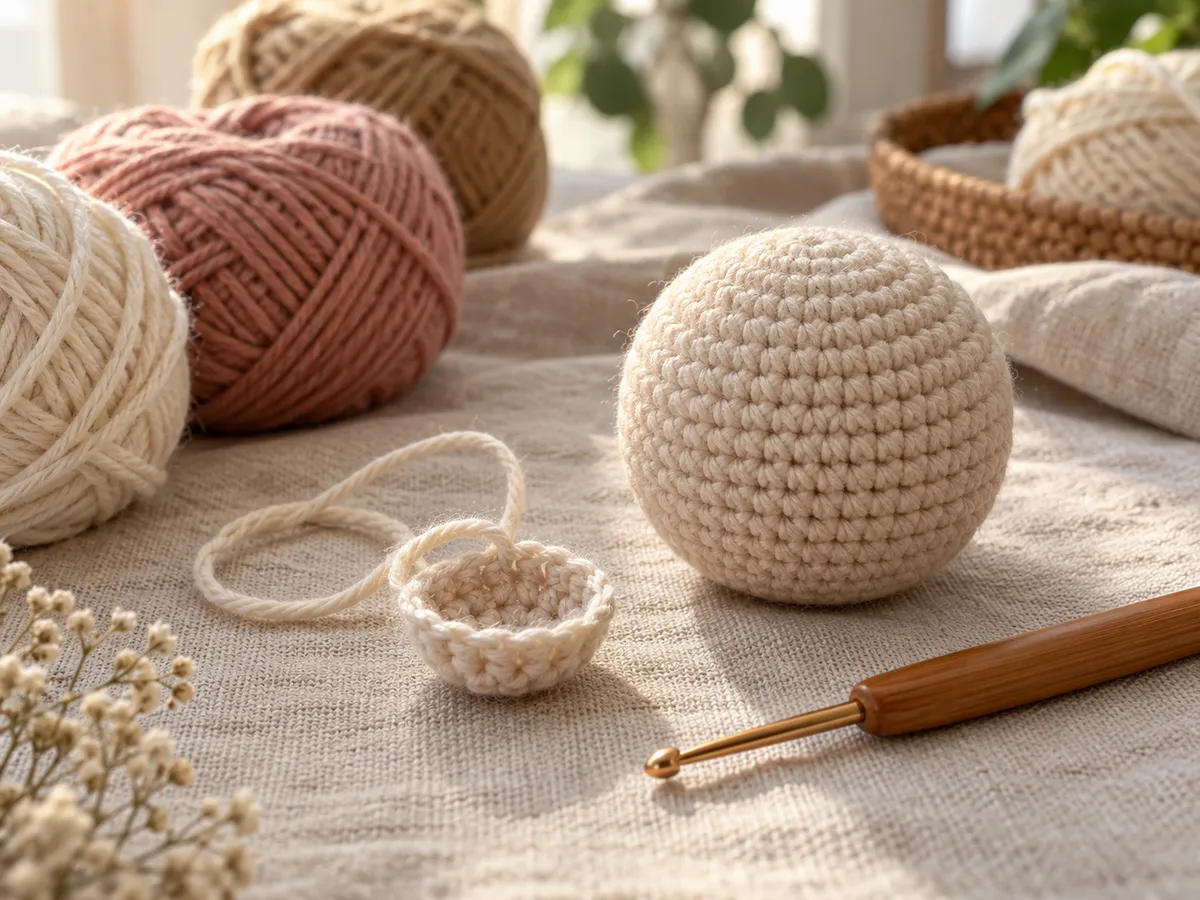
An amigurumi ball starts with 6 single crochet in a magic ring and grows by 6 stitches every round, so round k has 6 × k stitches: 6, 12, 18, 24 and onward. Work a few rounds even, then decrease 6 stitches per round, mirroring the increases, until 6 stitches remain and you close the hole.
The pattern behind the numbers is simple, and a stitch marker keeps it honest. The sections cover the magic ring, the count at the end of each round, how to stop the count from drifting, and how to stuff and close.
Key points
- Round 1 is 6 sc in a magic ring. Each increase round adds 6, so round k has 6 × k stitches.
- Increase rounds spread 6 increases evenly: round 3 is (sc, inc) × 6 = 18 stitches.
- Work even rounds at the widest count to give the ball its middle.
- Decrease rounds mirror the increases: 6 fewer stitches each round, back down to 6.
- Mark the first stitch of every round and count at the end of each round.
The magic ring in brief
A magic ring (also called an adjustable ring) is a loop of yarn that you crochet into and then pull closed, so the center has no hole. Lion Brand notes that standard amigurumi patterns begin with 6 single crochet in the ring, written "MR 6". After the 6 stitches are made, pull the yarn tail steadily and the center cinches shut. If nothing moves, you are pulling the working yarn instead of the tail.
Place a stitch marker in the first stitch before you close the ring. That marker shows where each round begins, and you move it up into the first stitch of every new round.
Why the ball grows by 6 each round
Six stitches make a small flat circle. To keep the circle flat as it grows, each round needs the same number of extra stitches, and here that number is 6. An increase means 2 sc in the same stitch, so six increases per round add six stitches. Round 2 has an increase in every stitch (12). Round 3 alternates 1 sc and 1 increase (18). Round 4 works 2 sc then an increase (24). The number of plain stitches between increases goes up by one each round, which is how the increases stay evenly spaced.
Round-by-round counts for a 36-stitch ball
This example grows to 36 stitches. The number of even rounds is a choice that shapes the ball; this example uses six. The crochet pattern generator on this site works out the rounds for the size you choose.
| Round | Instruction (US terms) | Stitch count |
|---|---|---|
| 1 | 6 sc in magic ring | 6 |
| 2 | inc in each st around | 12 |
| 3 | (sc, inc) × 6 | 18 |
| 4 | (2 sc, inc) × 6 | 24 |
| 5 | (3 sc, inc) × 6 | 30 |
| 6 | (4 sc, inc) × 6 | 36 |
| 7–12 | sc in each st around (even) | 36 |
| 13 | (4 sc, sc2tog) × 6 | 30 |
| 14 | (3 sc, sc2tog) × 6 | 24 |
| 15 | (2 sc, sc2tog) × 6 | 18 |
| 16 | (sc, sc2tog) × 6 | 12 |
| 17 | sc2tog × 6 | 6 |
Decreases mirror the increases
A decrease (sc2tog) works two stitches together into one, so six decreases remove six stitches. Each decrease round is the matching increase round played backward: round 13 uses 4 sc between decreases, just as round 6 used 4 sc between increases. Lion Brand describes the same sphere logic: increase each round to the widest point, then decrease symmetrically to close.
Stuff the ball firmly when about 18 stitches remain, around round 15 in the table. After that, the opening is small and stuffing is hard to push in. Add a little more after round 16 if needed.
Keeping the count from drifting
Amigurumi is usually worked in a continuous spiral without joining, so the marker is the only way to see where a round ends. Count the stitches at the end of every round and compare with the table. A count that is one off usually means a missed stitch next to the marker or an increase worked in the wrong place.
- Move the marker into the first stitch of each new round.
- Count at the end of each round: 6, 12, 18, 24, 30, 36.
- On even rounds, the count stays at 36 every time.
- Count again after each decrease round: 30, 24, 18, 12, 6.
Closing the ball
With 6 stitches left, cut the yarn, leaving a tail. Thread the tail on a yarn needle and pass it through the front loop of each of the last 6 stitches, then pull it tight to close the hole, the same way the magic ring closed the start. Pass the needle through the ball and out the other side, then trim the tail so the end hides inside the stuffing.
Common questions
- Why start with 6 single crochet in the magic ring?
- Six stitches make a small flat circle that grows evenly by 6 per round. Lion Brand notes that standard amigurumi patterns start with 6 sc in the ring, written MR 6.
- How many stitches are in round 5?
- Each round has 6 times its round number while increasing, so round 5 has 6 × 5 = 30 stitches. The instruction is (3 sc, inc) repeated 6 times.
- Can I use a chain start instead of a magic ring?
- Yes. Lion Brand suggests a chain-2 start as an option if the ring is difficult, but the magic ring closes the center with no hole, which looks cleaner on a ball.
- How do I make a larger ball?
- Keep adding increase rounds: round 7 is (5 sc, inc) × 6 = 42 and round 8 is (6 sc, inc) × 6 = 48. Then work even and decrease through the same counts in reverse.
About this page
Written and reviewed by Lucy, Editor, Needle Nook. Last reviewed . General craft guidance; check your own gauge and measurements before cutting or stitching.
Facts on this page follow these references:
- Magic Ring Crochet Tutorial: A Beginner's Guide ↗Lion Brand Yarn
- What Is Amigurumi Crochet: a Beginner's Guide ↗Lion Brand Yarn
- Crochet Abbreviations Master List ↗Craft Yarn Council