How Much Bias Tape Does a Yard of Fabric Make?
A yard of 40"-wide cotton gives about 518" (14.4 yd) of 2 1/2" continuous bias tape, 576" at 2 1/4". Formula, chart from a fat quarter to 1 1/4 yards, square method.
https://needlenook.app/learn/how-much-bias-tape-from-a-yard-of-fabric
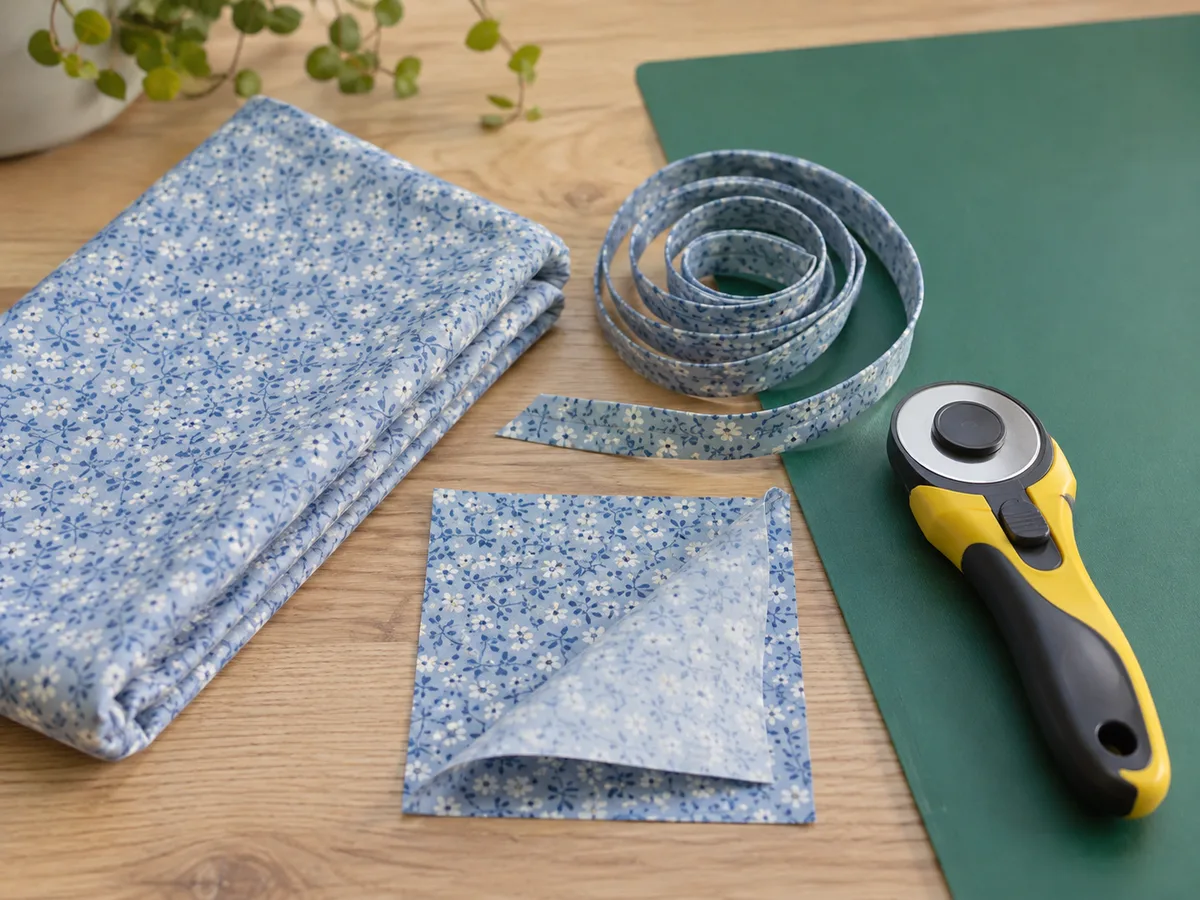
One yard of quilting cotton makes about 518" (14.4 yards, 13.2 m) of 2 1/2" continuous bias tape, or about 576" (16 yards) of 2 1/4" tape. The arithmetic is usable area ÷ strip width, less 10% for the two seams and the trimmed ends: 36" × 40" = 1,440 square inches, ÷ 2.5 = 576", × 0.9 = 518".
Every figure on this page assumes 40" of usable width after the selvages are trimmed, a fat quarter planned at 18" × 20", and the continuous (tube) method. The chart below covers a fat quarter, 1/2 yard, 1 yard and 1 1/4 yards at both strip widths, then the square method for a known binding length. Measure your own fabric after prewashing before you cut.
Key points
- Bias tape length ≈ fabric area ÷ strip width, less about 10% for the two seams and the trimmed ends.
- 1 yard at 40" usable: about 518" (14.4 yd) of 2 1/2" tape or 576" (16 yd) of 2 1/4" tape.
- A fat quarter gives about 129" of 2 1/2" tape, 1/2 yard about 259", 1 1/4 yards about 648".
- For a known length, cut a square with side √(length × strip width): 274" of 2 1/2" binding needs a 27" square (QUILTsocial).
- Bias binding takes more fabric than straight-grain binding: a 60" × 72" quilt needs 1/2 yard cut straight but 5/8 yard cut on the bias.
The formula: area ÷ strip width, less an allowance
Continuous bias tape is cut from a square or rectangle that is sewn into a tube, so almost the whole piece becomes strip. The length is the usable area divided by the strip width. Two seams and the trimmed ends take a little of that, and the last partial strip along the edge is waste, so this guide deducts 10% and rounds down to a whole inch. QUILTsocial's method uses the same area idea in reverse: multiply the length you need by the strip width to get the square inches, then take the square root to size the square.
The 10% is a planning allowance, not a measurement. A reader comment under the QUILTsocial post reports 234" of 4" strip from a 32" square, about 9% under the 256" the area alone promises, which is the kind of shortfall the allowance covers. Narrow strips lose a little less; wide strips lose a little more.
- Usable area = usable width × length. One yard at 40" usable is 36 × 40 = 1,440 square inches.
- Theoretical length = area ÷ strip width. 1,440 ÷ 2.5 = 576".
- Planned length = theoretical × 0.9, rounded down. 576 × 0.9 = 518".
- Yards = inches ÷ 36. 518 ÷ 36 = 14.4 yards.
Bias tape yield chart: fat quarter to 1 1/4 yards
Each cell is the planned length after the 10% allowance, with yards in brackets. A fat quarter is planned at 18" × 20" after the selvage is trimmed, the same planning size used in the fat quarter guide; the yardage cuts are planned at 40" usable width. Strips of 2 1/4" and 2 1/2" are the two widths most quilt bindings call for; narrower strips give proportionally more tape.
| Fabric cut | Usable size | 2 1/4" strips | 2 1/2" strips |
|---|---|---|---|
| Fat quarter | 18" × 20" | 144" (4.0 yd) | 129" (3.6 yd) |
| 1/2 yard | 18" × 40" | 288" (8.0 yd) | 259" (7.2 yd) |
| 1 yard | 36" × 40" | 576" (16.0 yd) | 518" (14.4 yd) |
| 1 1/4 yards | 45" × 40" | 720" (20.0 yd) | 648" (18.0 yd) |
Worked example: binding a 60" × 72" quilt on the bias
The binding guide on this site puts the binding length for a 60" × 72" quilt at 274": the perimeter of 264" plus 10" for joining and corners, which is QUILTsocial's allowance. On the bias with 2 1/2" strips, a half yard gives about 259", which is 15" short. The next cut up, 5/8 yard (22 1/2" × 40" = 900 square inches), gives 900 ÷ 2.5 × 0.9 = 324", enough with 50" to spare. A full yard gives 518", so it binds this quilt with about 244" left for the next project.
Cut on the straight grain, the same quilt needs only 7 strips of 2 1/2" across the width, which is 17 1/2" of fabric and rounds up to 1/2 yard. Bias binding costs one 1/8-yard step more here, and the gap grows with the quilt.
The square method for a known length
When you know the length you need, QUILTsocial's steps give the square to cut. For the 274" example: 274 × 2.5 = 685 square inches; the square root of 685 is 26.17", rounded up to a 27" square. A 27" square comes from 27" of 40"-wide fabric, which is 3/4 yard, and leaves a 13" × 27" strip over for something else. The rectangle approach above uses the whole 5/8-yard cut instead, so it needs less fabric but leaves nothing spare.
The method itself is short. Cut the square in half on the diagonal, sew the two triangles together along a straight edge into a parallelogram, mark lines parallel to the bias edges at the strip width, offset the ends by one strip and sew them into a tube, then cut along the marked line in one continuous spiral. QUILTsocial notes there is always some leftover at the end; cut as much full-width strip as you can and discard the rest.
Straight grain or bias?
Strips cut across the width of fabric are quicker to cut and use less fabric, and they suit a quilt with straight edges. Quilters usually turn to bias strips for curved edges and scalloped borders, because a bias strip stretches and bends around a curve without pleating. Both are cut at the same width and both follow the same length rule, perimeter plus 10", so only the fabric needed changes.
What to check before you cut
Measure the usable width of your fabric after prewashing and with the selvages removed; if it is less than 40", put your own width into the area step and the yield falls in proportion. Confirm the strip width your binding method or tape maker needs, because 2 1/4" and 2 1/2" give different lengths from the same piece. Square up the fabric before marking the diagonal: a true 45-degree cut is what makes the strip bias. Finally, add 10" to the perimeter for the binding length, as the binding guide does, before you compare it with the chart.
Common questions
- How much bias tape does a fat quarter make?
- About 129" (3.6 yards) of 2 1/2" tape or 144" (4 yards) of 2 1/4" tape, planned on 18" × 20" of usable fabric. That is enough to bind a small project such as a placemat or a bib, but not a quilt.
- How much fabric do I need for 300 inches of 2 1/2 inch bias binding?
- By the square method, 300 × 2.5 = 750 square inches and the square root is 27.4", so cut a 28" square, which takes 3/4 yard of 40"-wide fabric. By the area method, 5/8 yard (22 1/2" × 40") gives about 324" after the 10% allowance, so 5/8 yard is enough if you use the whole rectangle.
- Does bias binding use more fabric than straight-grain binding?
- Yes. The same 274" of binding for a 60" × 72" quilt takes 1/2 yard cut across the width but 5/8 yard cut on the bias, and a square cut for the same length needs 3/4 yard. The seams and the partial strip at the edge of the tube account for the difference.
- Does the fold change how much tape I get?
- No. The length depends only on the strip width you cut. Put the cut width your tape maker or pattern asks for into the formula; folding the strip single or double afterwards does not change its length.
About this page
Written and reviewed by Claire, Editor, Needle Nook. Last reviewed . General craft guidance; check your own gauge and measurements before cutting or stitching.
Facts on this page follow these references: