How Many Granny Squares for a Blanket?
Squares across × squares down: a 66" × 90" twin takes 165 six-inch squares, a 50" × 60" throw 80. Chart for baby to king blankets with 4", 5", 6" and 8" squares.
https://needlenook.app/learn/how-many-granny-squares-for-a-blanket
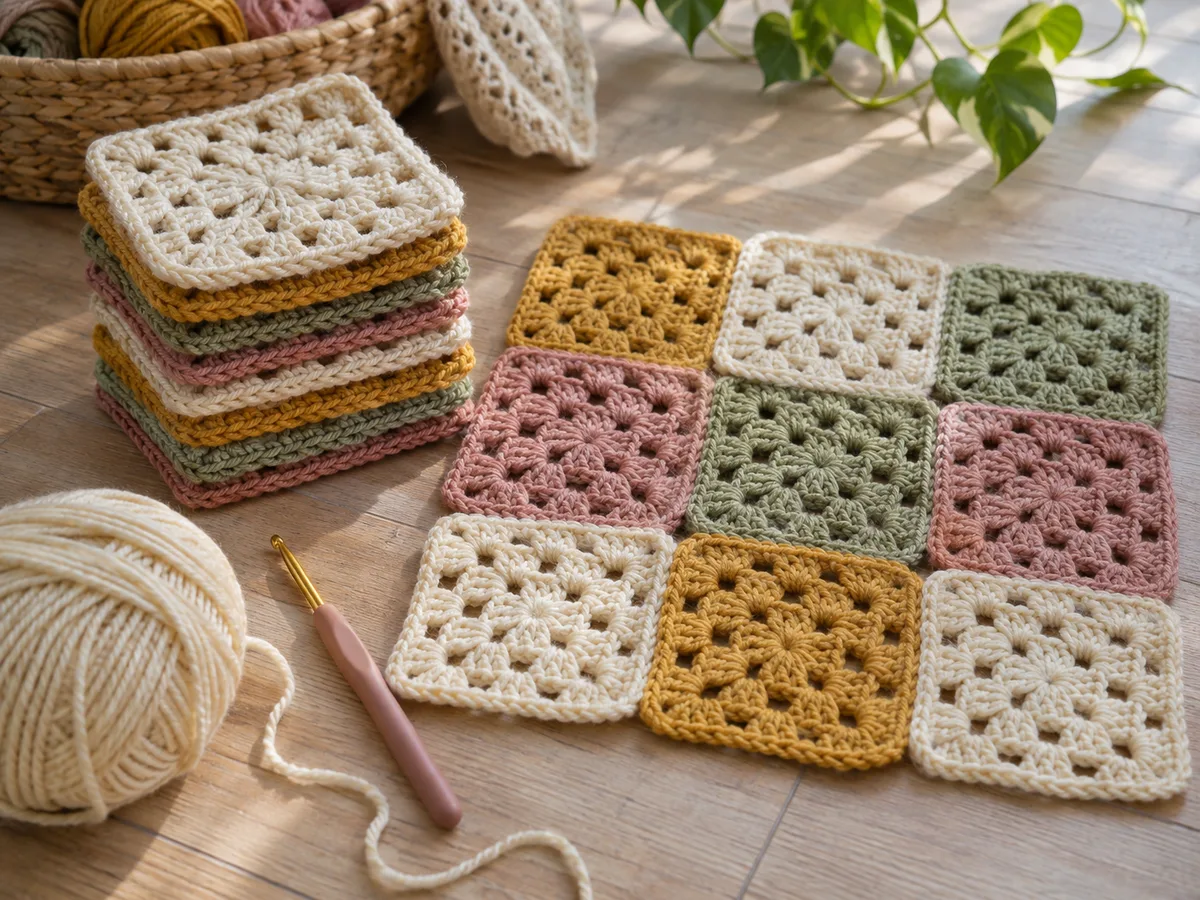
Divide the blanket size by the square size, each way, and multiply: a twin blanket of 66" × 90" made from 6" squares takes 11 across × 15 down = 165 squares. A 50" × 60" throw takes 120 squares at 5", 80 at 6" or 48 at 8" (finishing at 48" × 64").
Every count here assumes squares measured after blocking and rounded to the nearest whole square each way, the same rule as the granny mode of the crochet pattern generator. Blanket sizes come from Sleep Foundation and Handy Little Me. Joining and a border add a little, so make one square, block it and measure it before you buy all the yarn.
Key points
- Squares across = blanket width ÷ square size; squares down = length ÷ square size; round each to the nearest whole square, then multiply.
- With 6" squares: baby 30" × 40" = 35, throw 50" × 60" = 80, twin 66" × 90" = 165, queen 90" × 90" = 225, king 108" × 90" = 270.
- Rounding changes the size a little: 6" squares give a 30" × 42" baby blanket and 8" squares a 48" × 64" throw.
- Yarn: yards for one square × number of squares, plus 10% for ends and joining.
- The AAP advises no loose blankets in a baby's sleep space; use a baby blanket for awake, supervised time.
The formula: squares across × squares down
Measure one blocked square, then divide the blanket width by it for the squares across and the length by it for the squares down. Each answer is rounded to the nearest whole square, which is what the granny mode of the crochet pattern generator does, so the finished blanket can be a little larger or smaller than the target. Multiply the two numbers for the total.
- Twin blanket 66" × 90" with 6" squares: 66 ÷ 6 = 11 across.
- 90 ÷ 6 = 15 down.
- 11 × 15 = 165 squares, finishing at 66" × 90" before joining and border.
- Baby blanket 30" × 40" with 6" squares: 40 ÷ 6 = 6.67, rounded to 7 down, so 5 × 7 = 35 squares and 30" × 42".
Granny squares chart by blanket size
Each cell is the total, with across × down in brackets. Larger squares mean fewer squares to make and join, but each one takes longer and the size steps are coarser. With 12" squares the counts are 20 for a throw, 48 for a twin, 64 for a queen and 72 for a king.
| Blanket | 4" squares | 5" squares | 6" squares | 8" squares |
|---|---|---|---|---|
| Baby 30" × 40" | 80 (8 × 10) | 48 (6 × 8) | 35 (5 × 7) | 20 (4 × 5) |
| Throw 50" × 60" | 195 (13 × 15) | 120 (10 × 12) | 80 (8 × 10) | 48 (6 × 8) |
| Twin 66" × 90" | 391 (17 × 23) | 234 (13 × 18) | 165 (11 × 15) | 88 (8 × 11) |
| Full 80" × 90" | 460 (20 × 23) | 288 (16 × 18) | 195 (13 × 15) | 110 (10 × 11) |
| Queen 90" × 90" | 529 (23 × 23) | 324 (18 × 18) | 225 (15 × 15) | 121 (11 × 11) |
| King 108" × 90" | 621 (27 × 23) | 396 (22 × 18) | 270 (18 × 15) | 154 (14 × 11) |
Finished size after rounding
Because each direction is rounded to whole squares, the blanket you get is a whole number of squares wide and long. The table shows the finished size before joining and border for 6" and 8" squares; if a size matters, pick the square size that lands closest, or add a border to make up the difference.
| Blanket | Target | 6" squares | 8" squares |
|---|---|---|---|
| Baby | 30" × 40" | 30" × 42" | 32" × 40" |
| Throw | 50" × 60" | 48" × 60" | 48" × 64" |
| Twin | 66" × 90" | 66" × 90" | 64" × 88" |
| Full | 80" × 90" | 78" × 90" | 80" × 88" |
| Queen | 90" × 90" | 90" × 90" | 88" × 88" |
| King | 108" × 90" | 108" × 90" | 112" × 88" |
Blanket sizes used here
Sleep Foundation lists standard blankets at twin 65–66" × 90", full 80–85" × 90", queen 90" × 90–100" and king 108" × 90–100", and calls 50" × 60" the standard throw. Handy Little Me gives the same twin, full, queen and king sizes for crochet blankets, a throw of 50" × 60" to 54" × 72" and a baby blanket of 30" × 40" to 36" × 48", and notes that all of these are approximate. This guide uses the smaller figure of each range; for a longer drop over the bed, enter your own size in the generator.
For a baby blanket, the American Academy of Pediatrics guidance is that there should be no blankets, pillows, stuffed toys or bumper pads in a baby's bed. Sleep Foundation adds that crib blankets are meant for children at least 12 months old. A crocheted baby blanket is lovely for the stroller or for supervised time on the floor; keep it out of the crib for a young baby.
The square itself: one example round
Pattern abbreviations, as the Craft Yarn Council defines them: ch = chain stitch, ch-sp = chain space, dc = double crochet, sl st = slip stitch, rnd = round. US double crochet (dc) is called treble (tr) in UK patterns. In the classic granny square the generator writes out, each round adds one 3-stitch cluster per side: round n has 4n clusters and 12n stitches, so round 4 ends with 48 stitches.
Round 2 in US terms: ch 3 (counts as first dc), (2 dc, ch 2, 3 dc) in the corner space, then (3 dc, ch 2, 3 dc) in each of the next three corner spaces, join with sl st. The same row in UK terms: ch 3 (counts as first tr), (2 tr, ch 2, 3 tr) in the corner space, then (3 tr, ch 2, 3 tr) in each of the next three corner spaces, join with ss. Count 24 stitches at the end of the round.
Yarn: measure one square, then multiply
The generator does not guess yardage. It asks how much yarn one finished square used, multiplies by the number of squares and adds 10% for ends and joining. As an example only, if one 6" square used 9 yards, a 165-square twin blanket needs 165 × 9 × 1.1 = 1,633.5, about 1,634 yards, and an 80-square throw about 792 yards. Your own square will differ with yarn, hook and tension; Handy Little Me also notes that a granny square blanket uses a different amount of yarn than a plain double crochet one.
- Make one square in your yarn and hook, and block it.
- Unravel a second test square and measure the yarn, or weigh one square and use the yards per gram on the label.
- Multiply by the number of squares and add 10%.
- Divide by the yards per skein and round up to whole skeins.
What to check before you start
Block your first square and measure it across the middle; that is the size to divide by. Check a few later squares against it, because tension changes over a long project. Decide how you will join the squares, since a crocheted join and a border both add to the width and length. Finally, buy enough yarn of one dye lot for the main color at the start, so the last squares match the first ones.
Common questions
- How many 6 inch granny squares do I need for a throw blanket?
- For a 50" × 60" throw: 50 ÷ 6 = 8.33, rounded to 8 across, and 60 ÷ 6 = 10 down, so 80 squares. The blanket finishes at 48" × 60" before joining and a border.
- How many granny squares for a queen size blanket?
- For 90" × 90": 225 squares at 6" (15 × 15), 121 at 8" (11 × 11, finishing at 88" × 88") or 64 at 12" (8 × 8, finishing at 96" × 96").
- How big is a granny square?
- It depends on your yarn, hook and the number of rounds, so there is no single size. Make one square with the yarn and hook you plan to use, block it and measure it, then use that number in the formula. The crochet pattern generator writes out each round with its stitch count.
- What is dc in UK crochet terms?
- US double crochet (dc) is treble crochet (tr) in UK terms, and the US slip stitch (sl st) is often written ss in UK patterns. The US vs UK crochet terms guide lists the full set side by side.
About this page
Written and reviewed by Ivy, Editor, Needle Nook. Last reviewed . General craft guidance; check your own gauge and measurements before cutting or stitching.
Facts on this page follow these references:
- Blanket Sizes 101: A Complete Guide to Styles and Dimensions ↗Sleep Foundation
- Crochet Blanket Sizes Chart + How Much Yarn You Need ↗Handy Little Me
- Crochet Abbreviations Master List ↗Craft Yarn Council
- A Parent's Guide to Safe Sleep ↗HealthyChildren.org (American Academy of Pediatrics)